Wednesday, 27 July 2011

ISCO Industries Utilizes DataCore Software and Xiotech to Take Its Virtualization Infrastructure and VDI to the Next Level

http://vmblog.com/archive/2011/07/21/isco-industries-utilizes-datacore-software-to-take-its-virtualization-infrastructure-and-vdi-to-the-next-level.aspx

Blazing Fast Performance


“Our performance has gone through the roof,” continued Duncan. “It was not unusual to see 10, 15, or 20 milliseconds of latency on a read prior to DataCore and Xiotech. And that was on volumes that were dedicated to Tier 1 storage only. Now it is one or two milliseconds, tops, on most of our transactions. Moreover, reports from the ERP system are literally blazing through – they hardly take any time at all compared to what we were used to.”

With DataCore’s caching software and the high-speed Xiotech running in tandem, system administrators have seen more than a 35 percent increase in speed and responsiveness from the company’s terminal and mail servers.

ISCO Industries, a worldwide polyethylene pipe distributor, has implemented DataCore’s newest software release, SANsymphony-V. The company is running nearly fully virtual after implementing DataCore and VMware to virtualize the majority of its desktops, servers and storage infrastructure. Deployed in combination with Xiotech storage, DataCore’s SANsymphony-V added a new level of flexibility and productivity and most importantly it addressed the persistent performance problems as well as the capacity management issues that ISCO Industries faced with its previously existing storage area network (SAN).

“Prior to implementing SANsymphony-V, the performance and latency issues we faced were hurting our efficiency in many different areas,” stated Kim Byram, director of business and information systems at ISCO Industries. “Now, with DataCore and Xiotech running in tandem, we have seen our latency issues completely disappear. Plus our speed of backups and response time in generating reports has been cut drastically. More efficiency means more systems uptime and no more systems slowdown because you no longer have processes and backups running during somebody’s working hours.”

Four years ago, ISCO deployed a SAN from Compellent (acquired by Dell) to cope with the storage growth the company was experiencing as it virtualized its entire network. However, ISCO kept hitting a proverbial performance “wall” and system administrators would have to scramble to add storage space because the Compellent SAN was falsely reporting that it had maxed-out its capacity.

When DataCore was deployed on Xiotech, the IT team migrated data over to the new system, which was thin-provisioned through DataCore storage virtualization software. “We went from nine or ten terabytes of used space down to six terabytes of available space just by doing the migration,” notes T.J. Duncan, system administrator at ISCO. “In terms of capacity management and higher utilization rates, we have seen enormous benefits and now we have means of recovering disk space without having to create new volumes all the time.”

Today, DataCore’s SANsymphony-V serves as ISCO’s de facto SAN, and is responsible for managing and serving storage across the entire infrastructure. This enables the company to get the most out of its infrastructure with its software-based storage virtualization approach. “With our existing SAN, things were coming to a creeping halt on our network,” explained Byram. “And when we moved everything over to the very reliable Xiotech platform, we learned that we actually had a lot less data than what was being reported by our previous SAN.”

Blazing Fast Performance
“Our performance has gone through the roof,” continued Duncan. “It was not unusual to see 10, 15, or 20 milliseconds of latency on a read prior to DataCore and Xiotech. And that was on volumes that were dedicated to Tier 1 storage only. Now it is one or two milliseconds, tops, on most of our transactions. Moreover, reports from the ERP system are literally blazing through – they hardly take any time at all compared to what we were used to.”

With DataCore’s caching software and the high-speed Xiotech running in tandem, system administrators have seen more than a 35 percent increase in speed and responsiveness from the company’s terminal and mail servers. Now that the DataCore-Xiotech solution now manages 13 terabytes of total data, ISCO started seeing the following benefits:

  • Cost containment – DataCore has saved ISCO at least $100,000 because they were able to re-purpose six existing servers supporting VMware ESX and use them to create the DataCore disaster recovery SAN server, as well as ESX servers for disaster recovery, and the DataCore VDI server.
  • Risk reduction – For the first time, the UNIX system which is the company’s “bread and butter,” is now fully redundant. The entire system and all of the data is synchronized in real-time to the disaster recovery site, where a second UNIX server is maintained. Before, if ISCO lost its data, it would have taken the company 16-24 hours to get the main accounting and sales system back up and running. Now, the company can do this in minutes.
  • Improved productivity – Productivity improvements are tied to the better responsiveness of the terminal servers and virtual desktops being supported. All servers have had 10-20 percent improvement in performance just by putting in the SANsymphony-V and Xiotech solution.

VDI, Servers, and Storage: End-to-End Virtualization Reduces Costs and Risks

According to ISCO, the company is nearly fully virtualized. It uses terminal servers as well as a virtual desktop infrastructure (VDI), depending on the users and their needs. VMware vSphere is used both for servers and desktops. Four VMware hosts run VMware ESX 4.1 at the production data center. There are 32 VMs running from that. The VMs comprise servers dealing with ISCO’s phone system, terminal servers, a web monitoring server (NIMBUS), and file sharing servers.

DataCore storage virtualization software runs both on both the production SAN and the disaster recovery SAN. Asynchronous replication is used to replicate UNIX system data remotely, and the company plans to embrace synchronous replication in the near future for added business continuity. DataCore’s newest release, SANsymphony-V, is deployed on another server to support the VDI environment. VDI consists of two hosts and 20 VMs. Ten virtual desktops are supported as well as 8 terminal servers in a load-balanced pool. Between 15 and 18 people per server are using VDI at any given point in time.

Monday, 25 July 2011

New Case Study additions: n|Frame, Harting Technology Group, The WIŚNIOWSKI Company and Municipality of Casalecchio di Reno

n|Frame and DataCore: Empowering Cloud and IT services for Web and mission-critical applications to perform without fail

http://www.datacore.com/Testimonials/nFrame.aspx


Harting Technology Group: DataCore Storage Virtualization Software Lowers Cost of Ownership and Accelerates Performance for SAP and Critical Enterprise Applications

http://www.datacore.com/Testimonials/Harting-Technology-Group.aspx

For the SAP environment specifically, this meant up to 30 percent faster server response times.

Additionally, the DataCore environment enabled the integrity testing of the SAP R3 databases, which once took eight hours, to now be completed in just two hours –a 400% speed-up.


The WIŚNIOWSKI Company: Large manufacturer of garage doors and fences selects DataCore SANsymphony-V

http://www.datacore.com/Testimonials/WISNIOWSKI.aspx

"Thanks to DataCore’s SANsymphony-V software our production is more efficient. The malfunction of a disk array does not disrupt or cause a stoppage of the whole company."


Municipality of Casalecchio di Reno Deploys DataCore’s Virtualization Sofware

http://www.datacore.com/Testimonials/Municipality-of-Casalecchio-di-Reno.aspx

“The DataCore solution fully answered all our needs, offering features and performance that were beyond our expectations. The DataCore virtualization software helped us cut down considerably both our hardware and energy costs,” states Andrea Ventura, IT manager for the Casalecchio di Reno Municipality.

Thursday, 21 July 2011

HP and DataCore Alliance Solution Brief


Check out the recently released Solution Brief which highlights how the combination of DataCore and HP can "Accelerate your virtualization plans" http://www.datacore.com/Libraries/Document_Library/DataCore-HP_Joint_Solution_Brief.sflb.ashx

Tuesday, 19 July 2011

DataCore Software’s Storage Virtualization Webcast Series Continues With Part Three: “Achieving Off-the-Charts Performance Management”

Storage virtualization is becoming a must-have in contemporary IT – Webcast series educates the storage industry on key aspects and challenges of managing storage

DataCore Software announced the upcoming, third installment of its “Storage Virtualization” webcast series with “Storage in the Fast Lane -- Achieving Off-the-Charts Performance Management.” This webcast will take place on Thursday, July 28, 2011 at 11:30 a.m. (EDT). To register, please visit: “Storage in the Fast Lane -- Achieving Off-the-Charts Performance Management.

Part Three: Storage in the Fast Lane -- Achieving Off-the-Charts Performance Management

This third installment of the webcast series will investigate the following:
  • What is performance management?
  • What are the challenges to performance efficiency?
  • How can storage virtualization help you to get the best performance from your infrastructure?

Join host and moderator Jon Toigo for Part Three of the 'Storage Virtualization for Rock Stars' webcast series. To register, please visit: “Storage in the Fast Lane -- Achieving Off-the-Charts Performance Management.

Link: https://www1.gotomeeting.com/register/804452936

Storage Virtualization WhitePapers and Reference Materials
To access the two previous webcasts and the tutorial guides from Part One and Part Two of the “For Rock Stars” webcast series – “Hitting the Perfect Chord in Storage Efficiency” and “Capacity Management’s Sweet Notes” – please visit:
http://www.datacore.com/Software/Closer-Look/webcasts.aspx


Tuesday, 28 June 2011

How Many Tiers Do You Want?

Two recent articles got me thinking about the current limitations of tiered storage, and where it’s going. Ellen Messmer at Network World reported on some comments by Gartner analyst Stanley Zaffos about the chaos in the public cloud storage market. Some vendors, such as Amazon and Nirvanix, are gung-ho on public cloud storage, while others, like Iron Mountain and EMC, have pulled out of the business. While the cost comparison looks more than favorable—Gartner’s estimates is about 75 cents to a dollar per gigabyte per month for in-house storage vs. as low as 3 cents for cloud storage—Zaffos rightly points out the many variables IT needs to consider, among them latency, limited bandwidth, and security. In his remarks, He called out a couple of alternatives to public cloud storage, including a hybrid approach mixing public and private storage—in effect, making public cloud storage just another tier.

At CTOEdge, Mike Vizard has been talking for some time about the rising importance of data management and storage systems to deal with a world in which “multiple tiers of storage are soon going to be the rule rather than the exception.” In a recent blog post, he discusses building a new tier of storage for what he calls “warm data,” which requires access speeds somewhere between production applications and everything else (e.g., backup, archive, DR). He noted IBM’s new Netezza High Capacity Appliance, which isn’t so much a storage tier as a packaged storage application that gives quicker access to petabyte-sized data warehouses to satisfy compliance requirements.

These are two extremes of the storage spectrum, and a good illustration of some of the drivers behind the evolution of tiered storage, which is all about matching networked storage capabilities to application and business needs (e.g., speed, capacity, availability, security). In an ideal world, every application would have exactly the right kind of storage (i.e., infinite tiering granularity). In the real world, differences among technologies, vendors, protocols, and the like make this impractical, and the actual granularity possible with tiered storage is very low, which means that each tier is a compromise.

Like Mike Vizard, I’m convinced that the evolution of storage is taking us in the direction of more and more tiers to deliver a better match to application requirements. We’re going to see low-cost cloud storage treated as just another tier, for services like archiving and long-term backup. We’re going to see increasingly capable private cloud solutions with an increasing variety of tiers within them. And we’re going to see the “fragmentation” of what today we call “managed services” into an increasingly granular menu of capabilities like high availability, disaster recovery, compliance support, and similar “tiers” of storage-based services.

Storage virtualization software, with its ability to abolish storage silos, is going to be a major part of this evolution. The key will be its adoption by more and more service providers like Host.net and External IT who will use it in their own data centers and their customers’ data centers to provide seamless access to storage that matches application and business needs at a very fine granularity, whether in-house or out in the cloud. The result will be a storage environment in which IT can basically dial in as many tiers as they need, without worrying about the cake collapsing on them.


Photo by Pink Cake Box.

Friday, 17 June 2011

Are Storage Costs Driving You Crazy?


Almost thirty years ago novelist and screenwriter Rita Mae Brown defined insanity as “doing the same thing over and over again but expecting different results.” I’m quite certain she didn’t have storage hardware purchasing in mind when she wrote that, but it’s a perfect description of the usual IT strategy in this regard: buy more.

To be fair, I’ll admit that it’s not like IT has a lot of choice. Factors like server and desktop virtualization (Gartner predicts a 600% growth in storage capacity over the next three years due to these technologies alone), increasingly onerous data retention regulatory requirements, and the growth of rich media are driving an ever-increasing demand for storage. But the situation is definitely one in which “business as usual” is simply insane. It’s time for an intervention.

To explain, I’m going to turn to Jon Toigo, Chairman of The Data Management Institute LLC, who is a master of the “picture worth a thousand words.”
Even a cursory glance at his infographic shows the primary reasons why storage hardware is driving IT crazy.

First off, storage accounts for between one-third and three-quarters of IT hardware spending.

Second, the annualized total cost of ownership for storage is four to five times the initial acquisition expense. Putting in the boxes is just the start of your adventure: now you have to manage the storage, protect the data (e.g., backup, mirroring, etc.), and pay for power and cooling.

Third—and this is definitely crazy-making—once you’ve got all this wonderful storage in place, you find that you can’t use it efficiently: only about 30% of your storage ends up doing anything really useful. The rest is inert, allocated but unused, orphaned, or used to store stuff that’s of no use to your business.

That means you have to buy three times as much storage as you need just to make sure you don’t run out. But that just puts you back in the same insane loop, and you won’t get different results no matter how much storage you throw at the problem.

So you need to stage an intervention. And it can’t be a half-way effort, either.

The solution to this craziness is storage virtualization, which can boost your storage efficiency dramatically, make data protection easier, and reduce your storage management burden, all of which will drive down your storage costs as a percentage of IT spend. (You can get more details on storage virtualization and storage efficiency in Jon’s new white paper, Storage Virtualization for Rock Stars.)

But you have to take it all the way. Leaving storage virtualization capabilities locked up in proprietary array vendor controllers will leave you with islands of storage and put you right back in the inefficiency loop, albeit at a higher level. You’ll be hostage to your storage hardware vendor when it comes to expanding your storage infrastructure, and find it difficult to eke the maximum useful life out of your arrays as they reach end-of-support.

Better to declare your entire independence from storage craziness with storage virtualization software that’s vendor-agnostic and endures over multiple generations of hardware. That way you can squeeze the maximum efficiency out of your existing storage infrastructure and be free to add new storage from any source, on your schedule and within your budget, while your storage virtualization software continues to handle the details of efficiency, data protection, and management as it always has.

Now that’s sanity.

Graphic Source: Toigo Partners International, LLC

Wednesday, 15 June 2011

New IDC White Paper on DataCore ROI/TCO, New Jon Toigo Paper on Storage Efficiency

Check out the Updated Industry Analyst and Expert Opinions Page on the DataCore Website
Recently updated with the latest reports and the analysts like those at Gartner Group who are briefed and cover DataCore Software
http://www.datacore.com/Testimonials/What-Others-are-Saying/Analyst-Reports.aspx

White Paper on Storage Virtualization Software and Storage Efficiency
Download the latest 'Must Read' white paper on Storage Efficiency by Jon Toigo: STORAGE VIRTUALIZATION FOR ROCK STARS Part 1: Storage Efficiency
It does a great job of overviewing the benefits of Storage Virtualization Software and covering the compelling economics.

IDC White Paper on DataCore: Achieving the Full Business Value of Virtualization with a Scalable Software-Based Storage Virtualization Solution
An excellent paper on the value proposition of virtualization software for storage by IDCs Rick Villars, the top expert on virtualization and storage virtualization: http://www.datacore.com/Libraries/Document_Library/The_Business_Value_of_Software-based_Storage_Virtualization.sflb.ashx

IDC Opinion & Summary

Today's information-based economy demands that IT managers enhance the business value of existing and planned IT investments while simultaneously reducing the costs of IT operations. Server consolidation and broader adoption of server virtualization are some of the key strategies IT teams are counting on to meet these goals.

Dealing with storage, however, is one of the most critical technical and economic roadblocks to broad adoption of virtualization in many of these organizations. Limits include the up-front direct cost associated with replacing storage with complex networked storage systems, the added operational cost of managing networked storage systems, and the inherent inefficiencies of many of these storage systems.

Storage virtualization software such as DataCore's SANsymphony-V addresses many of these challenges. It allows organizations to make better use of "in place" storage assets while also ensuring that IT organizations can fully achieve a return on their investments in a virtualized server environment. They can achieve these goals by quickly taking advantage of the rapid cost declines and performance increases available in today's standard server platforms. IDC finds that the use of virtualized storage with solutions such as DataCore's makes it possible for companies to:

  • Consolidate storage and server assets
  • Increase the number of virtualized servers running on individual physical servers while doubling storage utilization rates for installed storage
  • Leverage lower-cost/higher-capacity storage tiers that can significantly cut the cost of acquiring new storage assets
  • Improve application and information availability while shrinking backup times
  • Significantly reduce the cost to meet the performance and business continuity objectives of virtualized IT organizations

DataCore Software Names Former Citrix Executive as Vice President of Worldwide Marketing, More...

Linda Haury to direct DataCore's strategic marketing efforts

“DataCore is positioned to become a powerhouse in one of the industry’s fastest growing software segments,” said Haury. “Coming out of the desktop and server virtualization space, I can tell you firsthand how essential they are to virtualization projects. Needless to say, I’m eager to commence this exciting role.”

Virtual Strategy Magazine:
http://www.virtual-strategy.com/2011/06/09/datacore-software-names-former-citrix-executive-vice-president-worldwide-marketing

Sandhill.com:
http://www.sandhill.com/news/exec_moves.php?id=569

IT Director:
http://www.it-director.com/business/change/news_release.php?rel=25506

SNSeurope:
http://www.snseurope.com/news_full.php?id=18505&title=DataCore-Software-names-former-Citrix-executive-as-Vice-President-of-Worldwide-Marketing

VirtualizationWorld:
http://www.virtualizationworld365.net/news_full.php?id=18505&title=DataCore-Software-names-former-Citrix-executive-as-Vice-President-of-Worldwide-Marketing

VMblog:
http://vmblog.com/archive/2011/06/09/datacore-software-names-former-citrix-executive-as-vice-president-of-worldwide-marketing.aspx

ChannelEMEA:
http://www.miamiherald.com/2011/06/09/2258385/datacore-software-names-former.html


Big Data: The Time is Now for Managing It and Leveraging the Advantages
http://www.dbta.com/Articles/Editorial/Trends-and-Applications/Big-Data-The-Time-is-Now-for-Managing-It-and-Leveraging-the-Advantages-75883.aspx

Big Data Storage

Leveraging the advantages big data has to offer in terms of global insight and better customer understanding requires smarter data management practices. Consider the storage side of the issue, another matter that makes big data perplexing to many organizations and administrators. A sizable segment of companies with fast-growing data stores in the IOUG survey spend more than one-fourth of their IT budgets on storage requirements.

Data growth is quickly becoming out of control and drives over-spending when it comes to data storage. Despite increasing IT budgets, the growing costs associated with storing more data create a data affordability gap that cannot be ignored. The response to this growth has been to continue funding expansion and add hardware. Technology advances have enabled us to gather more data faster than at any other time in our history which has been beneficial in many ways. Unfortunately, in order to keep pace with data growth, businesses have to provision more storage capacity which drives costs.

While there has been a relentless push in recent years to store multiplatform data on ever-larger disk arrays, big data demands moving in a different direction. "In contrast to years past, where information was neatly compartmentalized, big data has become widely distributed, scattered across many sites on different generations of storage devices and equipment brands-some up in the clouds, others down in the basement," George Teixeira, president and CEO of DataCore Software, tells DBTA.

As result, centralized storage is "both impractical and flawed," Teixeira says. "It's impractical because it's incredibly difficult to lump all that gargantuan data in one neat little bucket. It's flawed because doing so would expose you to catastrophic single points of failure and disruption." To address widely distributed data storage, he recommends approaches such as storage virtualization software, backed up by mirror images of data which are kept updated in at least two different locations. "This allows organizations to harness big data in a manner that reduces operational costs, improves efficiency, and non-disruptively swap hardware in and out as it ages," he says.


CIO update: The Pros and Cons of SSD in the Enterprise
http://www.cioupdate.com/trends/article.php/11047_3933741_2/The-Pros-and-Cons-of-SSD-in-the-Enterprise.htm

Storage virtualization software helps shape the shared storage infrastructure required by virtual IT environments and takes good advantage of SSDs where appropriate, reducing the write duty-cycle by caching upstream of the cards to minimize actual writes to media. This effectively extends the useful life of these premium-priced assets.

"It can also make modest sized SSDs appear to have much larger logical capacity by thin provisioning its resources," said Augie Gonzalez, director of Product Marketing at DataCore Software. "The sage advice is consider SSDs as one element of the physical storage configuration, but put your money on device-independent storage virtualization software to take full advantage of them."


TechNet Radio: IT Time - The “Caring and Feeding” for Shared Storage in Clustered Hyper-V Environments
http://64.4.11.252/en-us/edge/technet-radio-it-time-the-caring-and-feeding-for-shared-storage-in-clustered-hyper-v-environments.aspx?query=1

Its IT Time, and in today’s episode Blain Barton interviews Augie Gonzalez, Director of Product Marketing at DataCore Software. Tune in for this lively conversation as they discuss how DataCore’s SANsymphony-V can help solve potential storage related issues in Hyper-V clusters.


'Virtualizing' disparate storage resources
http://searchvirtualstorage.techtarget.com/tip/Virtualizing-disparate-storage-resources

Would you like to get a point-in-time snapshot of your disparate storage resources regardless of which disk array supplier houses your data? Would you like to create a universal storage pool out of your Fibre Channel, SCSI, EIDE, and IBM SSA drives? Would you like to substantially improve performance yields from equipment already on your floor?

According to DataCore Software, these are just a few of the advantages that network storage pools powered by the company's SANsymphony are providing - without shutting down, rewiring, or overloading application servers.

"Currently, anyone who has legacy SCSI disk arrays alongside Fibre Channel and EMC boxes are having to use various, vendor-specific utilities to monitor and control their storage resources," says Augie Gonzalez, director of product marketing for DataCore Software. "With SANsymphony, a central administrator can take overall custody of disparate storage resources in a homogeneous way. No longer do they have to be overwhelmed by each particular disk vendor's administrative nuances."

Gonzalez says SANsymphony's built-in caching algorithms are adding new value to existing storage assets. "Many people have equipment on the floor that doesn't live up to its performance potential," he says. "Now you can come in after the fact and accelerate their I/O response time..."

Thursday, 9 June 2011

DataCore Software Helping New Zealand's Leading Port Company to Build Virtualized Storage Infrastructure

http://virtualization.tmcnet.com/topics/virtualization/articles/183063-datacore-software-helping-new-zealands-leading-port-company.htm

A key player in storage virtualization and iSCSI SAN software, DataCore Software Corporation recently announced the deployment of its DataCore SANsymphony storage virtualization software by Ports of Auckland, New Zealand’s leading port company.

Ports of Auckland is going to use the software to create a dynamic and resilient virtual storage infrastructure. In order to deploy SANsymphony advanced storage virtualization software, the company will not require to make changes in hardware. Thus the investment is expected to help cost-effectively support the port company’s server virtualization environment as well as its business model.

One of the largest in New Zealand, Ports of Auckland supports the international trade on a 24/7 basis by providing a broad range of cargo handling and logistics services. Although the server infrastructure at Ports of Auckland is extensively virtualized, its aging Storage Area Network (SAN) was disrupting IT processing at critical hours, the company revealed in a press release. But upgrade was difficult as it would have disrupted its operations. By deploying DataCore SANsymphony, the IT team is now able to keep applications running while switching out equipment with just a few minutes’ notice, officials at DataCore explained in the release.

According to managing director of APAC at DataCore Software Peter Thompson (News - Alert), DataCore’s storage virtualization software allows Ports of Auckland to move to a shared pool of storage and realize greater efficiency and business continuity as well as the ability to quickly react to new and expanding workloads placed on its systems.

“With DataCore, we have seen the benefits first-hand of improved uptime and being able to do operational maintenance without affecting our business. This gives us peace of mind. We’re also getting better utilization out of our storage hardware, and need less of it to achieve greater performance. With DataCore in place, our performance has been nothing short of phenomenan,” lead systems engineer at Ports of Auckland Craig Beetlestone commented in a statement.

The deployment of DataCore SANsymphony storage virtualization software has given Ports of Auckland and the IT team confidence that they are now in control of the company’s infrastructure.

“Looking forward, it’s good knowing that SANsymphony’s advanced storage virtualization features stay in place even as the hardware underneath changes. There’s none of the throw away we’ve experienced in the past when the functional intelligence was buried in the devices,” Beetlestone further explained.

The Port of Aukland Case Study and more info are available at: http://www.datacore.com/Testimonials/Ports-of-Auckland.aspx

Ports of Auckland is New Zealand’s leading port company, serving the country’s vital international trade with a broad range of cargo handling and logistics services on a 24x7, 365-day-a-year basis. Ports of Auckland is responsible for running two maritime ports and an inland port in the Auckland region.

In 2010, the ports handled cargo equivalent to 13 percent of the country’s total GDP, twice as much as any other New Zealand port. Its east-coast Auckland seaport accounts for 37 percent of New Zealand’s total container trade. Ports of Auckland connects New Zealand’s importers and exporters with more than 165 international ports in nearly 70 countries.

Ports of Auckland Embarks on Storage Virtualization with DataCore Software to Keep Business Processes Flowing Smoothly and Reduce IT Costs
http://www.virtual-strategy.com/2011/06/02/ports-auckland-embarks-storage-virtualization-datacore-software-keep-business-processes-f


http://virtualization.sys-con.com/node/1858216


Computer Technology Review: Ports of Auckland deploys DataCore Software to keep business processes smooth and reduce IT cost
http://www.wwpi.com/index.php?option=com_content&view=article&id=12833:ports-of-auckland-deploys-datacore-software-to-keep-business-processes-smooth-and-reduce-it-costs-&catid=231:storage-software&Itemid=2701181


DataCenter Journal: Storage Virtualization for Ports of Auckland
http://www.datacenterjournal.com/index.php?option=com_content&view=article&id=4742:storage-virtualization-for-ports-of-auckland&catid=142:the-daily-buzz&Itemid=100366


http://vmblog.com/archive/2011/06/02/ports-of-auckland-embarks-on-storage-virtualization-with-datacore-software-to-keep-business-processes-flowing-smoothly-and-reduce-it-costs.aspx

Tuesday, 7 June 2011

DataCore Software's SANsymphony-V Takes Industry by Storm

Solving the "Big Challenges" Stalling Today's Server and Desktop Virtualization Projects, Brings DataCore Widespread Industry Accolades


http://vmblog.com/archive/2011/06/01/datacore-software-s-sansymphony-v-takes-industry-by-storm.aspx

“We implemented DataCore software to protect our VMware environment from glitches in our storage infrastructure,” states Warren D. Nisbett, senior assistant managing director, Management Information Systems Unit, St. Kitts-Nevis-Anguilla National Bank Ltd. “SANsymphony-V automatically replicates our virtual machine images and their data in real-time to our other hot site. Moreover, our system performance has greatly improved. We stand behind our selection of SANsymphony-V because it performs as advertised.”

DataCore Software announced broad praises and widespread momentum for its newest software release, SANsymphony- V. This next-generation solution eliminates storage-related barriers that prevent IT organizations from realizing the financial and operational goals of their virtualization initiatives.

“We have large data storage needs and found the flexibility we were seeking in SANsymphony-V,” states Peter Dobler, assistant vice president, Corporate MIS Dept., Northeast Health. “Moreover, SANsymphony-V’s interface is head and shoulders above what I am used to for storage management. It is very intuitive and easy to use. SANsymphony-V has made our end-to-end virtualization initiatives a reality. We virtualized our core network with Cisco and our servers with both VMware vSphere and Citrix XenServer. SANsymphony-V was the final piece. Storage virtualization with SANsymphony-V rounded the whole thing out and it has worked really well.”

According to George Teixeira, president and CEO of DataCore Software, “The industry accolades and positive customer feedback speaks to the timeliness, relevance and value implicit in SANsymphony-V. While many had looked at virtualization from the narrow perspective of servers and desktops, they now recognize how our storage virtualization software forms the critical third dimension to a hardware-independent strategy.”

Announced in January 2011, SANsymphony-V software enables data centers to use existing equipment and conventional storage devices to achieve the robust and responsive shared storage environment necessary to support highly dynamic virtual IT environments. This contrasts sharply with the expensive “rip and replace” approaches being proposed to support desktop and server virtualization projects.

“We deployed SANsymphony-V at all of our global affiliate locations,” says Jane Cebula, director, Global Infrastructure, SI Group. “We needed to protect our VMware environment by ensuring that data was synchronously mirrored and highly available. Now our data is secure because with SANsymphony-V we can replicate data in real-time to a secondary location, rather than contracting out for our D/R needs.”

In recent weeks, many independent assessments of DataCore’s impact to the virtualization segment have been conducted. These include:

Industry Analyst Recognition:

  • Enterprise Strategy Group (ESG) Lab Validation Report – Results of comprehensive hands-on testing and performance benchmarking validated key value propositions of SANsymphony-V. The ESG Lab team summarized its test conclusions by stating: “ESG Lab firmly believes that it would benefit any organization considering or implementing an IT virtualization project to take a long look at DataCore SANsymphony-V R8 storage virtualization software. It is robust, flexible, and responsive and delivers major value in terms of utilization, economics, improved response times, high-availability, and easy administration.”
  • Taneja Group Profile “Building the Virtual Infrastructure with DataCore SANsymphony-V” was released earlier this year by leading industry analyst firm, Taneja Group. As part of the profile, Taneja highlights DataCore’s solutions and use cases in Microsoft’s environment and touts that “For Hyper-V users that would like to build an enterprise-capable virtual infrastructure, DataCore SANsymphony-V is an ideal fit.”
To download the full ESG Lab Validation Report and Taneja Group Profile, please visit: DataCore Software – Featured Analyst Reports.

Product Reviews:

  • eWEEK “Product to Watch” eWEEK, the industry leader for strategic technology information, named SANsymphony-V one of its “Products to Watch” for 2011. Editors distinguished DataCore for using “software to reshape server and disk resources already in use in order to meet the unpredictable workloads that virtual machines and virtual desktops throw at newly consolidated data centers.” The “Products to Watch” article appears in the February 21, 2011 print edition of eWEEK.
  • IAIT Independently Validates SANsymphony-V – After closely examining SANsymphony-V newly-added features and capabilities, independent IT analysis experts at the Institute for the Analysis of IT components (IAIT) concluded that the product “offers an extremely efficient central administration tool for storage virtualization with synchronous mirroring for high availability, asynchronous replication for disaster recovery and further important function like virtual disk pooling, thin provisioning, snapshots for backups and restores as well as CDP for Continuous Data Protection.” To download the full IAIT SANsymphony-V product review, please visit: DataCore Software – Product Reviews.

Awards:

  • Everything Channel’s CRN 2011 Partner Programs Guide / 5-Star Partner Rating – DataCore was named to the Everything Channel CRN 2011 Partner Program Guide and was awarded a 5-Star Partner rating for the second straight year. As the definitive authority on vendors who have robust partner programs or products that service solution providers offer directly to the IT channel, Everything Channel recognized the DataCore Partner Program as offering a program that provides the best possible partnering elements for channel success.
  • 2011 Network Computing Award – DataCore gained additional recognition in Europe by winning one of the the UK’s top networking accolades by scooping the Data Center Product of the Year Award at the prestigious 2011 Network Computing Awards. Established in 2005 to recognize best-of-breed, easy to use solutions that make the lives of network administrators and managers easier and more effective, readers had the opportunity to vote across a two month time period across several categories. The “DataCore Tackles Storage Virtualization Barrier” review appeared in the February issue of Network Computing.
“We implemented DataCore software to protect our VMware environment from glitches in our storage infrastructure,” states Warren D. Nisbett, senior assistant managing director, Management Information Systems Unit, St. Kitts-Nevis-Anguilla National Bank Ltd. “SANsymphony-V automatically replicates our virtual machine images and their data in real-time to our other hot site. Moreover, our system performance has greatly improved. We stand behind our selection of SANsymphony-V because it performs as advertised.”

More Information
Extensive reference material and supporting videos of SANsymphony-V may be found at the SANsymphony-V launch page: http://www.datacore.com/Software/Products/SANsymphony-V.aspx.

DataCore Software's SANsymphony-V Garners Widespread Momentum

http://it.tmcnet.com/topics/it/articles/181706-datacore-softwares-sansymphony-v-garners-widespread-momentum.htm

SANsymphony-V has garnered widespread momentum and praise. It is designed to remove the storage-related barriers that prevent IT organizations from realizing the financial and operational goals of their virtualization initiatives.

SANsymphony-V is a version of DataCore’s SANsymphony storage virtualization software that is tuned specifically for virtual server and virtual desktop environments. It can also be used in physical environments, as well as a mix of virtual and physical.

TMCnet recently reported that the solution is capable of solving difficult storage-related challenges introduced by server and desktop virtualization, cloud computing and more general expansion, business continuity, and disaster recovery initiatives.

Monday, 6 June 2011

127 Million and Counting

That’s the number of person-hours lost each year to IT outages in North America and Europe, according to a new survey commissioned by CA Technologies. It’s an eye-catching number, equivalent to almost 64,000 people unemployed for a year, but there were other numbers in the survey that caught my attention.

For instance, a third of the organizations surveyed didn’t have a disaster-recovery policy in place, despite the fact that most them understood that downtime can damage their reputation, staff morale, and customer loyalty, and almost a fourth of the companies said that failure to recover data would be disastrous. The numbers also revealed that employee productivity suffered almost as much during data recovery as it did during the downtime itself.

Even more interesting was the fact that something like 95% of those lost hours come from small businesses with less than 500 employees. Of course, that’s mostly due to the fact that there are so many small businesses compared to larger firms, but I’m sure there’s also a “we can’t afford disaster recovery or high availability” mentality at work. How many of those lost hours could be reclaimed if businesses realized that in the era of virtualization, DR and HA no longer require specialized hardware and expensive duplication of resources?

Server virtualization combined with storage virtualization software makes it possible to use standard server hardware and disks—fancy arrays entirely optional—to make disaster recovery what it should always be—a last resort—by assuring business continuity and zero-downtime recovery with synchronous replication. It works if you have 200 TB of data spread across multiple metro clusters, and it works if you’re a small business dependent on a private cloud. Adding storage virtualization software to your virtualization playbook means you can put all your hardware to work, all the time, and stop worrying about being a downtime statistic.

Photo by Justin Marty


Friday, 3 June 2011

Videos from Citrix Synergy 2011; Latest Whitepaper and Webcast - The Storage Virtualization for Rock Stars Webcast Series Part 1: Hitting the Perfect Chord in Storage Efficiency

Check out the latest Webcast: The Storage Virtualization for Rock Stars Webcast Series Part 1: Hitting the Perfect Chord in Storage Efficiency
http://www.datacore.com/Software/Closer-Look/webcasts.aspx


Brian Madden at Citrix Synergy 2011: A video demo of DataCore
In this video from Citrix Synergy 2011 San Francisco, Datacore's Rob Griffin shows off SANsymphony-V and how it can be used to virtualize storage for VDI environments.
http://www.brianmadden.com/blogs/morevideos/archive/2011/05/31/citrix-synergy-2011-a-video-demo-of-datacore.aspx


VMblog interviews Matt Zucker on DataCore at Citrix Synergy 2011

http://events.vmblog.com/video-interviews/interview-datacore

and at:
http://vmblog.com/archive/2011/05/26/citrix-synergy-2011-datacore.aspx


Sabrina Gelado Interview at the Citrix Synergy Both
http://www.citrix.com/tv/#videos/4035


DailyMotion creates a DataCore Video Playlist
http://www.dailymotion.com/playlist/x1kne2_datacorevideos_datacore-playlist-english/1#videoId=xhuyri


Are You Getting Storage Efficiency Backwards?

http://www.datacore.com/storage-virtualization-viewpoint-blog/11-05-31/Are_You_Getting_Storage_Efficiency_Backwards.aspx


SNSeurope DataCore Customer Video
http://www.snseurope.com/tv_full.php?id=322&title=DataCore-Software---Customer-Testimonial


Thursday, 2 June 2011

Are You Getting Storage Efficiency Backwards?

Private cloud storage has been much in the news lately: it’s well up along the “hype cycle.” So it was refreshing to see some cautionary words from IBM the other day at the company’s Storage Innovation Executive Summit. Although Big Blue is one of the biggest players in cloud computing—they have a stake in every aspect of it—VP Dan Galvan warned attendees about a common misconception that’s fueling a lot of the private cloud storage hype.

“Cloud computing isn't about storage efficiency. It’s backward, because storage efficiency is how you enable the private cloud.” He went on to recommend implementing technologies such as storage virtualization, automated tiering, and thin provisioning as first steps towards the efficiency needed for private cloud storage.

Exactly right. Couldn’t have said it better myself, even though I’ve had years of practice talking about just those technologies. Talking, and listening to the customers who have used them to increase their storage efficiency.

Along the way I’ve learned that storage efficiency has multiple dimensions, and you have to take them all into account in solving your storage equation. There’s the technical dimension, which involves parameters like storage utilization, performance, power consumption, and the like. There’s the business dimension, where the numbers are about total cost of ownership and ROI. And there’s the operational dimension, which, due to the rapid proliferation of data, is straight out of the Red Queen’s race in Through the Looking Glass: running as fast as you can just to stay in one place.

The only way to optimize all three of these storage efficiency dimensions is to follow the logic of virtualization all the way to the end. Just as you wouldn’t lock your server virtualization capabilities up in a single server box, you shouldn’t lock your storage virtualization capabilities up in a single array. With storage virtualization software that can run on the same standard server hardware you use for application virtualization, and which can virtualize all your storage, regardless of vendor, you’ll not only nail the technical numbers, but extend your existing storage investment for an even better ROI. And being able to manage all your storage assets from a single point, creating virtual disks with a few mouse clicks, means that IT will be doing a lot less running around.

Doing it any other way is just backwards.

Photo by Ross Berteig

Wednesday, 25 May 2011

Why be a Dummy, When You Can Be a Rock Star?

http://www.drunkendata.com/?p=3393

I don’t know about you, but I really don’t like those “For Dummies” books. Maybe I am put off by the idea of being seen carrying a book around that casts aspersions on what my detractors might call my already questionable skills and knowledge. Or maybe it is because a number of titles I have perused over the past couple of years — thin tomes passed out at trade show booths — seem to be more like vendor brochures than sources of meaningful information about technology.

In any case, when DataCore Software approached me to write a “For Dummies” guide to storage virtualization, my initial inclination was to pass on the project. For one thing, I had seen at least two other “Storage Virtualization for Dummies” books in that series, which has become a cottage industry for its publisher, neither of which I had found particularly insightful or probative — unless you just wanted to learn about a particular vendor’s gear.

Then there was that negative title. ”…For Dummies.”

Heck, I might be a dummy. But I don’t want to go around advertising it.

Then, they came back to me with a new idea that changed my mind.

Instead of the familiar black-and-yellow “For Dummies” book, why not do things differently: write a “For Rock Stars” guide. Heck, everyone wants to be a rock star (or did once, before their teeth started falling out of their heads).

As we discussed the project, I grew more and more comfortable with it. I didn’t need to focus on the capabilities and limitations of any one vendor’s product in the guide. Nor did I have to explore the minutiae of differences between one product or another (especially not in a way that was calculated to stilt the discussion in favor of DataCore or any other vendor). DataCore was already quite secure about their technology and the overall superiority and value of their product.

The idea was to articulate the concepts and implementation alternatives available to any IT professional who wanted to get his or her head around the technology.

Moreover, the concept was settled upon to make the entire project a kind of mixed media adventure. I would help to develop the book as a series of white papers, each delivered in concert with a webcast in which I will do the “lead riff” followed by experts from DataCore.

That sounded cool, prompting me to hit PhotoShop hard to develop some seminal art. Here’s the cover:

          Intro slide for webcast series Storage Virtualization for Rock Stars

Get ready to rock and roll this Thursday, assuming I can still talk. I will post the invite details shortly.

I should add that this will not only cover the errata of storage virtualization technology, but also the business value case for those of you who have the practical challenge of cost-justifying all expenditures to the bean counters in the front office — (a category that includes most of us today!)

Fact is, I am having a lot of fun helping to develop this program and hope it will get a lot of interest and attendance.

Special thanks to DataCore Software for sponsoring this endeavor. They are all true rock stars in my book.


Invitation to Would-Be Rock Stars


http://www.drunkendata.com/?p=3397

Per my previous post, it is my pleasure to pass along this invitation to participate in Thursday’s introductory installment of the Storage Virtualization for Rock Stars Webinar Series.

Greetings.

You are receiving this because I consider you part of the DataCore Software ecosystem — meaning that I have communicated with you either regularly, routinely, or for a specific purpose in the past. I wanted to “waive a flag” on behalf of a NEW webcast series we are doing in the hopes that you will attend the first one – Part 1: Hitting the Perfect Chord in Storage Efficiency — this Thursday, May 26th. For those who have not already done so, please register at your earliest convenience.

The Storage Virtualization for Rock Stars Webcast Series

Starting this week, DataCore will offer one webcast a month, running from May through October. Different topics under the storage virtualization umbrella will be tackled each time.

Please join us on Thursday, May 26th at 11:30 AM EDT for the first webcast in this series — Part 1: Hitting the Perfect Chord in Storage Efficiency. The webcast will last between 30 and 40 minutes and then we will conduct a Q&A at the end (hence the one-hour “duration” on the registration form). IT industry analyst and data storage luminary Jon Toigo will serve as host and moderator for the entire “For Rock Stars” webcast series.

Also please consider forwarding (or posting on your web site/blog) this short text to encourage any others in your organization to attend –

The Storage Virtualization for Rock Stars Webcast Series: Part 1: Hitting the Perfect Chord in Storage Efficiency
Thursday, May 26, 2011. 11:30 AM – 12:30 PM EDT.

While I don’t know how luminescent I will be given the condition of my dentata, I will give my solo everything I’ve got and will be delighted to hear George Teixeira, President and CEO of DataCore, and Tim Warden, Director of Systems Engineers, contribute their “tasty riffs.” And of course, I will moderate what I hope will be an energetic panel discussion at the end of the presos.

Be there or be square. (Did I say that?)

Tuesday, 24 May 2011

Don’t Build Your Cloud with Iron!

I suppose almost everyone remembers cloud-watching as a child: lying on your back outdoors watching them morph from horse to dragon to spaceship to—well, you could find almost anything in those solid-seeming billows drifting overhead. And if someone had asked you then what clouds are made of, I can imagine any number of answers, and not one of them would have involved iron.

But that’s precisely what big-iron storage vendors like EMC, NetApp, and others would like you to think. The hoopla at EMC World last week in Las Vegas got me thinking about this, such as this quote from EMC CEO Joe Tucci’s keynote: “virtualization is the key to the cloud. This is the year when most, if not all, mission critical applications get virtualized and run on cloud topologies. This will be the year when all IT professionals will understand the opportunities [presented by the cloud].”

I couldn’t agree more with the first sentence: virtualization is the key to the cloud. And I hope this is the year when everyone understands cloud opportunities: especially the opportunity to get out from under the iron clouds that storage hardware vendors are pushing. (That image that makes me want to cover my head and run for cover!)

Virtualization software like VMware and Microsoft Hyper-V makes it easy to create virtual machines from a cloud of common CPU and memory resources without worrying about the iron behind the scenes. That’s a huge productivity boost for IT, so why not do the same with storage? Point-and-click creation of virtual disks—no matter whose storage hardware is behind them—would sure beat pushing heavy iron around.

Not surprisingly, private cloud providers like External IT, Host.net, and iomart hosting have been quick to recognize this opportunity. The single point of failure, hardware lock-in, and expense of big-iron storage solutions made it hard for them to provide the agile, cost-effective, highly-reliable infrastructure that their customers demand. So they’ve moved on to storage virtualization software that runs in the cloud like everything else and transforms all their storage assets into a single pool of storage that can very rapidly be “carved up” into virtual disks for customer applications or servers.

The benefits they talk about include:
  • High availability with synchronous mirroring of all storage resources
  • Disaster recovery with asynchronous replication
  • Zero-downtime SAN hardware refreshes
  • Improved storage performance from intelligent software cache
  • No hardware lock-in and easy migration of older storage hardware to lower tiers

So forget the rivets and virtualize all the way down to keep your cloud soft and agile.


(Photograph taken by
Karin Dalziel)

Saturday, 21 May 2011

It Ain’t Easy Being ‘Green’ … Or Is It? Virtualization software makes an impact on waste.

Since Earth Day was proclaimed in 1970, protecting the environment has advanced from a grassroots effort to a global cause. We’ve all pitched in and taken steps to ensure the planet will be a healthy place to live for generations to come. From recycling to alternative sources of energy, the pursuit for a green future is on.

With the daily power consumption of a typical data center equivalent to the monthly power consumption of thousands of homes, it’s no surprise that a major focus of the green movement has turned to the data center. In fact, just this week The Green Grid Association announced new steps organizations can take to transform their data centers from an operational burden to a source of prosperity and sustainability.

But most of the hype around green data centers has focused on data center architecture, server consolidation, and new cooling strategies – and somehow ...

Full story

Thursday, 19 May 2011

Photos from DataCore at Microsoft TechEd 2011; Dancing DataCore GoBots ‘Hot’ item at the Show

Check out the photos and click on the video links to see the DataCore Dancing GoBots…


Dancing GoBots:

Jousting GoBot
Hula GoBot
Flava Flav GoBot

Also, check out the latest releases from the show:
DataCore Showcases Use Cases and Next-Generation Storage Virtualization Software, SANsymphony-V at Microsoft TechEd

Microsoft Tech-Ed 2011: DataCore Software Adds Extra Data Protection, Flexibility and Speed to Windows Home Server with DriveHarmony

DataCore Showcases WW User Testimonials and New Software at Microsoft Tech-Ed

http://www.it-director.com/technology/sys_mgmt/news_release.php?rel=24964&ref=fd_info

“Microsoft’s full range of virtualization solutions provide partners and customers with an effective way to save costs, increase availability, and improve agility within their business infrastructure,” said Mike Schutz, senior director of product management for the Server and Cloud division at Microsoft Corp. “By using Microsoft Windows Server 2008 R2 Hyper-V SP1 and Microsoft System Center, customers can also take advantage of DataCore SANsymphony-V and explore ways to reducethe cost of storage while delivering improved performance and availability.”

Enterprise-class Solution Purpose-Built for Windows Server 2008 R2

Cloud services provider AcXess, for example, is using DataCore’s SANsymphony™ software to create a dynamic, resilient virtual storage infrastructure that cost-effectively supports the company’s Windows Server 2008 R2 Hyper-V virtualization environment and its business model.

AcXess has built its business around flexible virtualisation technologies designed to meet the needs of key customers who rely on AcXess to provide reasonably priced services such as on-demand sales demos, proof-of-concept (POC) labs, and training sessions in virtualised environments to thousands of employees, partners, and customers. Using Windows Server 2008 R2 Hyper-V and DataCore, AcXess has doubled the number of users year over year and has grown its business 300 percent, while saving $5 million in hardware costs.

A full case study is available on Microsoft’s website.

Wednesday, 18 May 2011

DataCore Showcases Use Cases And Next-Generation Storage Virtualization Software, SANsymphony-V At Microsoft TechEd

http://www.bsminfo.com/article.mvc/DataCore-Showcases-Use-Cases-And-Next-0001

DataCore Software is showcasing its SANsymphony™-V solution at this week’s Microsoft Tech•Ed North America 2011 conference. SANsymphony-V is DataCore’s next-generation storage virtualization software solution that enables IT organizations to eliminate storage-related barriers preventing them from realizing the financial and operational goals of their virtualization initiatives.

“By using Microsoft Windows Server 2008 R2 Hyper-V SP1 and Microsoft System Center, customers can also take advantage of DataCore SANsymphony-V and explore ways to reduce the cost of storage while delivering improved performance and availability.”-Mike Schutz, senior director of product management for the Server and Cloud division at Microsoft Corp.

Tech•Ed 2011 takes place at the Georgia World Congress Center in Atlanta from Monday, May 16 until Thursday, May 19, 2011. DataCore is a Silver Sponsor and is exhibiting in Booth 1629.

To read more about DataCore’s solutions and use cases in Microsoft environments, download the Taneja Group profile, “Building the Virtual Infrastructure with DataCore SANsymphony-V.”

DataCore™ SANsymphony-V enables data centers to use existing equipment and conventional storage devices to satisfy shared storage requirements introduced by highly dynamic, virtual IT environments. It provides a Windows Server 2008 R2 Hyper-V SP1 based set of advanced storage virtualization functions to provision, share, reconfigure, migrate, replicate, expand, and upgrade storage. This cost-effectively speeds up applications, delivers uninterrupted data access, and extends the useful life of storage devices, contrasting sharply with the expensive “rip and replace” approaches being proposed to support desktop and server virtualization projects.

“Microsoft’s full range of virtualization solutions provide partners and customers with an effective way to save costs, increase availability, and improve agility within their business infrastructure,” said Mike Schutz, senior director of product management for the Server and Cloud division at Microsoft Corp. “By using Microsoft Windows Server 2008 R2 Hyper-V SP1 and Microsoft System Center, customers can also take advantage of DataCore SANsymphony-V and explore ways to reduce the cost of storage while delivering improved performance and availability.”

Enterprise-class Solution Purpose-Built for Windows Server 2008 R2

Two years in development, DataCore designed SANsymphony-V to meet the needs of midmarket end-users and solution-providers, especially those familiar with Windows Server 2008 R2 Hyper-V SP1 administration eager to adapt their IT operations to accommodate the many variables that server and desktop virtualization introduce. It is interoperable with Microsoft’s virtualization infrastructure, including Windows Server 2008 R2 Hyper-V SP1, System Center, and Failover Clustering.

While some vendors in the virtualization field recommend that customers lock themselves into specific storage hardware configurations and exotic purpose-built appliances, SANsymphony-V frees customers from hardware lock-in by decoupling the virtual infrastructure from the underlying disks. It also optimizes the I/O response obtained from standard storage devices that would have otherwise needed to be replaced. Then when customers need to expand capacity, they can simply choose the best deal at the time from a number of suppliers rather than be limited to one specific vendor’s hardware.

“Shared storage is often the ‘weak link’ in server and desktop virtualization initiatives; first as a performance bottleneck and then as a single point-of-failure. Many times, virtualization projects intended to reduce server or desktop costs hit the storage wall,” said George Teixeira, president and CEO of DataCore Software. “We employ sophisticated software portable and scalable across Windows Server 2008 R2 Hyper-V SP1 to overcome the storage-related roadblocks standing between IT organizations and their virtualization objectives.”

Real-world Successes Built on Virtualization Software
At Tech•Ed 2011, DataCore is also highlighting a number of customers that deploy Microsoft solutions in conjunction with a virtualized storage infrastructure powered by DataCore Software.

Cloud services provider AcXess, for example, is using DataCore’s SANsymphony™ software to create a dynamic, resilient virtual storage infrastructure that cost-effectively supports the company’s Windows Server 2008 R2 Hyper-V virtualization environment and its business model.

AcXess has built its business around flexible virtualization technologies designed to meet the needs of key customers who rely on AcXess to provide reasonably priced services such as on-demand sales demos, proof-of-concept (POC) labs, and training sessions in virtualized environments to thousands of employees, partners, and customers. Using Windows Server 2008 R2 Hyper-V and DataCore, AcXess has doubled the number of users year over year and has grown its business 300 percent, while saving $5 million in hardware costs. A full case study is available on Microsoft’s website.

More Information
Extensive reference material and supporting videos for SANsymphony-V may be found at on DataCore’s website: http://www.datacore.com/SANsymphony-V.

Additional resources, solution overviews, and product documents may be found on the DataCore website: http://www.datacore.com/Solutions/storage-virtualization-and-virtual-server-desktop/Microsoft/Resources.aspx and find out why the Taneja Group profile states, “For Hyper-V users that would like to build an enterprise-capable virtual infrastructure, DataCore SANsymphony-V is an ideal fit.”

Tuesday, 17 May 2011

Microsoft Tech-Ed 2011: DataCore Software Adds Extra Data Protection, Flexibility and Speed to Windows Home Server with DriveHarmony

http://usingwindowshomeserver.com/2011/05/17/datacore-driveharmony-public-beta-announced/

Welcomes beta testers to trial DriveHarmony’s new pooling, mirroring and caching features that boost performance and sidestep hard disk drive limitations

DataCore Software today announced the Beta release of DriveHarmony™, a simple to use add-on software package for Microsoft Windows Home Server (WHS). Users who are eager to protect, pool, accelerate, and easily expand storage capacity are welcome to request an early version of DriveHarmony for their personal beta testing by visiting DataCore’s booth (#1629) at this week’s Microsoft Tech•Ed 2011 or by sending a request to WHS@DataCore.com.

“With more and more content going digital, people increasingly want a simple way to access, store, and enjoy the wide range of photos, personal videos, music, and films they save at home”

Easily Pool and Expand Storage to Simplify File Sharing and Folder Management
Leveraging techniques learned from a decade of experience in large data centers across the globe, DataCore™ DriveHarmony maximizes the value home users get from their hard disk drives. The software integrates into the familiar WHS dashboard with a simple, easy-to-use control panel. From there, users can combine one or more physical disks of variable sizes and types into one “Virtual Big Disk” pool. When this virtual drive is created, it is automatically initialized, formatted, assigned a drive letter, and selectively mirrored for data protection. The virtual drive is then ready for use by any application running on the WHS 2011 operating system.

Growing with the Needs of Today’s Digital Lifestyle
As families and small businesses gather more digital assets, their disk space consumption naturally grows. DriveHarmony delivers the right combination of power, capacity, and ease-of-use for today’s home consumers. It allows them to expand appropriately by adding more drives to virtual disks without having to split up or re-organize their files. The rest is done behind the scenes without any need for intervention.

“With more and more content going digital, people increasingly want a simple way to access, store, and enjoy the wide range of photos, personal videos, music, and films they save at home,” said Carlos M. Carreras, vice president of alliances and business development, DataCore Software. “Through the gathering of feedback during the beta process, we look forward to working closely with Microsoft and the Windows Home Server Community to bring to market a powerful solution to help home users easily protect, organize, and manage their growing disk requirements in a digital age.”

Availability
DriveHarmony is currently in Beta release and will be rolled out via select OEMs later this year. Visitors to DataCore’s booth (#1629) at Microsoft Tech•Ed 2011 can request an early version of DriveHarmony for their personal beta testing. Tech•Ed takes place at the Georgia World Congress Center in Atlanta from Monday, May 16 until Thursday, May 19, 2011.

DataCore Attending Tech•Ed 2011

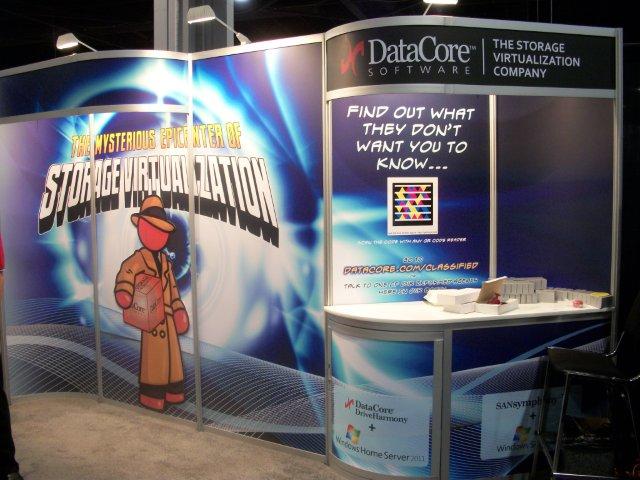
If you are in the Atlanta, GA area from May 16 through May 19, stop by Tech•Ed 2011 at the Georgia World Congress Center. Visit DataCore’s booth (#1629) where we’ll be “unlocking the mysteries” of storage virtualization and showcasing SANsymphony-V.

As part of a new initiative to extend our product line across the Microsoft Windows Server family, we will also be using Tech•Ed to highlight our newest software product, DriveHarmony, an easy to use add-on software application for Microsoft Windows Home Server (WHS). Due for general release in June, DriveHarmony offer WHS users pooling, mirroring and caching features that boost performance and sidestep hard disk drive limitations, functionality long familiar to DataCore enterprise customers. All visitors to our booth will be encouraged to sign up for the beta version for personal testing. We hope to see you there!

Visit our website for more information:
http://www.datacore.com/teched2011

See related blog post:
http://usingwindowshomeserver.com/2011/05/12/datacore-at-tech-ed/

Saturday, 14 May 2011

Guess Who’s Back, Back Again? … External Storage Fights the Hard Fight

It’s official.  According to Gartner, external controller-based disk storage has recovered from the global recession, exceeding the record sales figure from 2008 with revenue in 2010 of more than $19.4 billion (US).  Analyst Roger Cox commented that “enterprises and service providers alike are investing more in external storage as they virtualize servers and build cloud-based services.”

Here’s my prediction: the storage required to support the Clouds will remain too expensive until Clouds move to a hardware independent software-based storage virtualization model.

As with virtual desktops, potential private cloud customers are experiencing “sticker shock” due to demanding storage requirements.  This has slowed commercial interest.  Clouds by definition are software constructs that provide services as needed when needed.  To do so, the combination of virtual servers, virtual storage and virtual networks working together as a combined virtualization layer is the obvious choice.
From our perspective, a cloud computing platform ...

Full story

Thursday, 12 May 2011

New Case Study on Ports of Auckland

Performance has been nothing short of phenomenal.

Read the complete Case Study

The IT infrastructure at Ports of Auckland is extensively virtualized, but its aging Storage Area Network (SAN) was limiting critical application performance, required too much downtime for physical maintenance or upgrades, and could not furnish the high availability demanded by port operations. By deploying DataCore SANsymphony storage virtualization software, the IT team was able to guarantee a failover time of mere minutes, increase storage performance and utilization, and greatly reduce their storage infrastructure costs and management burden.

With SANsymphony, we have seen the benefits first-hand of improved uptime and being able to do operational maintenance without affecting the business. We’re getting better utilization out of our storage hardware, and need less of it to get the same performance. Lastly, we have peace of mind. We know we don’t have to throw away any functionality intelligence because we get to keep using SANsymphony software even as the hardware underneath changes.
- Craig Beetlestone, Lead System

Monday, 9 May 2011

It’s Not Rocket Science: The More Things Change, the More They Stay the Same

After the space shuttle Atlantis lifts off from the Kennedy Space Center in June, an era of NASA’s manned space exploration will come to a close. Nearly 50 years to the day after President John F. Kennedy called for a brave new era of space exploration, and 30 years after the launch of Columbia, NASA is bringing its three-decade-long Space Shuttle Program to a close. This is at a time when 2011 marks such a significant, historic year for the U.S. space program.

After completing 135 missions, the space shuttle – the workhorse and pride of the American space program – has finally outlived its benefit. It was originally devised because, at the time, a reusable spacecraft seemed much more economical than its one-and-done predecessors. And for 30 years, the space shuttle fulfilled its mission objectives thanks in part to one critical component: its design.

That’s right; the space shuttle’s main design has been unchanged for 30 years. Certainly, upgrades have been made here and there, but to the casual observer, it appears very much the same vehicle as it did in 1981. The “software” has been updated, but the hardware remains much the same. We see instances of this still to this day, where the life of hardware can be extended with smarter software.

How fitting that we see one example in an area that was born from NASA and the space program – storage virtualization. When converting to a virtualized environment, many will tell you that you need to make a costly upgrade investment to the storage infrastructure, if you want to run the latest software. And of course you’ll need to have the latest hardware. This is just not true.

Smarter virtualization software has shown that it can take advantage of just about any storage hardware and you don’t need the most powerful, fastest, or biggest anymore. That’s because the software is doing a lot of the heavy lifting. Just like with a car… if you want more oomph off the line, you don’t need a new engine, you just need to change the gear ratios and the shift points (the latter also being a software programming issue), in other words, use a smarter program to get much more from the same “old” engine. This is the same with storage virtualization projects.

Now don’t get me wrong, software cannot extend the life of hardware indefinitely. Eventually, your car engine will die, but hopefully after several hundred thousand miles. And the space shuttle will retire this year, only to be replaced by something newer.

Eventually, you may have to roll in some new devices, but smarter software can ensure that the investments you’ve already made won’t go obsolete anytime soon and can enjoy a long, healthy, and productive lifespan. Maybe people will be talking about your “old” disks, even 30 years from now.

Saturday, 7 May 2011

Is This The Year When Desktop Virtualization “Gets Real”? VMware Thinks So.

I recently came across the following article in Barron’s and I think it merits discussion. Financial analyst Louis Miscioscia of Collins Stewart gives some insight into what’s cooking at VMware, and interestingly, the virtualization leader believes that this is the year when desktop virtualization projects will transform from proof of concepts to real deployments.

The main reason for this adoption? The cost of deploying a virtualized desktop infrastructure (VDI) has dropped so significantly (about 70% cheaper) in just the past few years that it’s becoming a no-brainer from an investment perspective. The writer, Tiernan Ray, does point out that server virtualization deployments have far outpaced this uptick in VDI, so the bottom line is that there is a real uptick in the overall volume of virtualization projects going on right now. Maybe your own organization is dealing with this surge right now.

But as enterprises jump to on the ...

Full story