Friday, 13 November 2015

DataCore's Storage Virtualization Enables Any-to-Any Data Mirroring

George Teixeira, CEO & President and Nick Connolly, Chief Scientist at DataCore Software discuss how DataCore's Software-Defined Storage solution allows businesses to mirror their data across heterogeneous storage.


Synchronous Mirroring: Zero Downtime, Zero Touch High Availability
DataCore offers an enterprise-class high availability solution that is designed to avoid equipment and site outages from interrupting access to critical information flow. The goal is to deliver “zero downtime, zero touch” failover to maximize business continuity. The cost-disruptive software, proven in over 25,000 global deployments, constantly mirrors data at high speeds between geographically separate locations. It keeps active-active copies synchronized even when using different types of storage devices at each end. Local and stretched/metro clusters perceive the independent, mirrored copies as a single set of data, simultaneously reachable from either location over redundant paths.
For more information on DataCore's Synchronous Mirroring, see http://datacore.com/products/features/Sync-Mirroring-High-Availablility.aspx

Monday, 2 November 2015

DataCore Certifies Universal VVols - Brings VVols Benefits to Existing Storage and to Non-VVol Certified Storage

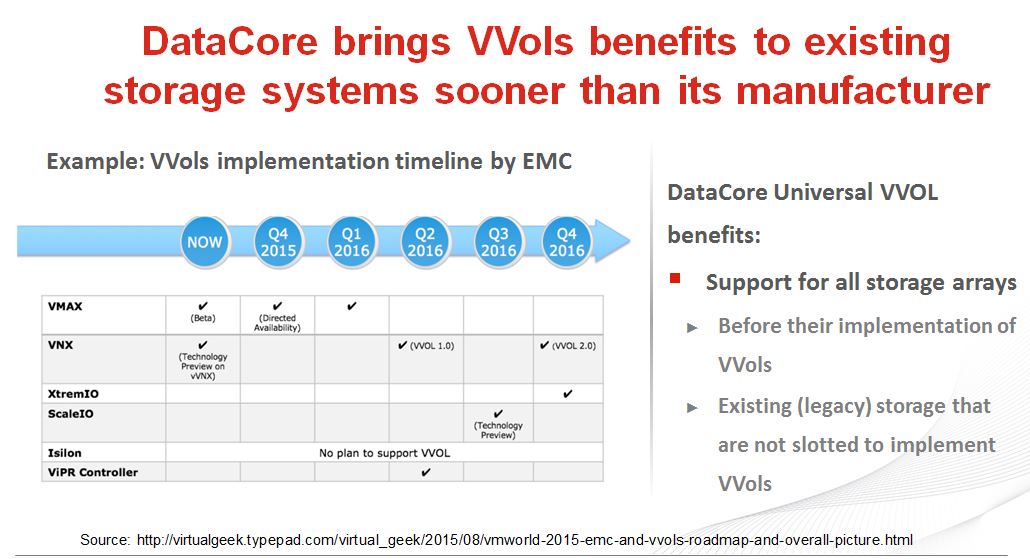
Universal Virtual Volumes: Extends VMware’s VVOL Benefits to Storage Systems that do not Support it
Many VMware administrators crave the power and fine-grain control promised by vSphere Virtual Volumes (VVOLs). However, most current storage arrays and systems do not support it. Manufacturers simply cannot afford to retrofit equipment with the new VM-aware interface.
DataCore offers these customers the chance to benefit from VVOLs on EMC, IBM, HDS, NetApp and other popular storage systems and all flash arrays simply by layering SANsymphony™-V storage virtualization software in front of them. The same is true for direct-attached storage (DAS) pooled by the DataCore™ Hyper-converged Virtual SAN.
Now, vSphere administrators can self-provision virtual volumes from virtual storage pools -- they specify the capacity and class of service without having to know anything about the hardware.


DataCore SANsymphony-V wins Reader’s Choice Award for Best Software Defined Storage Solution

Augsburg, Unterföhring, 30. Oktober 2015. Die Leser von Storage-Insider.de und IT-BUSINESS haben entschieden: DataCore gewinnt den Reader's Choice Award in der Kategorie Software Defined Storage.The TheThe readers of Storage-Insider and IT business have decided: DataCore wins the Reader's Choice Award for Best Software Defined Storage. Bei der großen Leserwahl der Vogel IT Medien setzte sich DataCore mit seiner SANsymphony-V-Software im Finale gegen Dell und Falconstor durch. In the readers' vote of Vogel IT Media DataCore prevailed with its SANsymphony-V software in the final against solutions from Dell, IBM  and FalconStor. Die Platinum-Auszeichnung wurde im Rahmen einer feierlichen Gala am 29. Oktober in Augsburg überreicht. The Platinum Award was presented at a gala event on 29 October.


"We are particularly pleased and proud to receive this award because this choice was made by the readers of some of the most important publications in our industry. IT professionals have selected SANsymphony-V as the best Software Defined Storage solution", Stefan of Dreusche, Director Central Europe at DataCore Software says.

http://datacore-speicher-virtualisierung.blogspot.com/2015/10/datacore-gewinnt-readers-choice-award.html

Thursday, 29 October 2015

Real-World Customers Validate DataCore's Data Availability Strategy

George Teixeira, CEO & President and Nick Connolly, Chief Scientist at DataCore Software share examples of customers who are using DataCore's Software-Defined Storage solution as an integral part of their data availability strategy as well as some of the software's unique capabilities to achieve High Availability.


Maimonides Medical Center, based in Brooklyn, N.Y., is the third-largest independent teaching hospital in the U.S. The hospital has more than 800 physicians relying on its information systems to care for patients around-the-clock. Click the link below to see DataCore Software interview Gabriel Sandu and Walter Fahey of Maimonides Medical Center about why they chose DataCore SANsymphony-V as their software-defined storage solution.

http://www.datacore.com/testimonials/video-testimonials/maimonides

Thursday, 22 October 2015

Virtualization Review: Back to the Future in Virtualization and Storage – A Real Comeback, Parallel I/O by DataCore

"It's a real breakthrough, enabled by folks at DataCore who remember what we were working on in tech a couple of decades back."

If you're on social media this week, you've probably had your fill of references to Back to the Future, the 1980s scifi comedy much beloved by those of us who are now in our 50s, and the many generations of video watchers who have rented, downloaded or streamed the film since. The nerds point out that the future depicted in the movie, as signified by the date on the time machine clock in the dashboard of a DeLorean, is Oct. 21, 2015. That's today, as I write this piece…

Legacy Storage Is Not the Problem
If you stick with x86 and virtualization, you may be concerned about the challenges of achieving decent throughput and application performance, which your hypervisor vendor has lately been blaming on legacy storage. That is usually a groundless accusation. The problem is typically located above the storage infrastructure in the I/O path; somewhere at the hypervisor and application software operations layer.
To put it simply, hypervisor-based computing is the last expression of sequentially-executing workload optimized for unicore processors introduced by Intel and others in the late 70s and early 80s. Unicore processors with their doubling transistor counts every 24 months (Moore's Law) and their doubling clock speeds every 18 months (House's Hypothesis) created the PC revolution and defined the architecture of the servers we use today. All applications were written to execute sequentially, with some interesting time slicing created to give the appearance of concurrency and multi-threading.
This model is now reaching end of life. We ran out of clock speed improvements in the early 2000s and unicore chips became multicore chips with no real clock speed improvements. Basically, we're back to a situation that confronted us way back in the 70s and 80s, when everyone was working on parallel computing architectures to gang together many low performance CPUs for faster execution.


A Parallel Comeback
Those efforts ground to a halt with unicore's success, but now, with innovations from oldsters who remember parallel, they're making a comeback. As soon as Storage Performance Council audits some results, I'll have a story to tell you about parallel I/O and the dramatic improvements in performance and cost that it brings to storage in virtual server environments.
It's a real breakthrough, enabled by folks at DataCore who remember what we were working on in tech a couple of decades back.

Friday, 16 October 2015

Achieving Universal Management and Control Across Heterogeneous Storage Infrastructure

In this video, George Teixeira, CEO & President at DataCore Software, highlights the key criteria decision makers should use to make an intelligent storage infrastructure choice. SANsymphony™-V10 is DataCore's flagship 10th generation storage virtualization solution. In use at over 10,000 customer sites, it maximizes IT infrastructure performance, availability and utilization by virtualizing storage hardware. For more details on SANsymphony-V10, click here.

Thursday, 15 October 2015

VMworld Europe 2015: DataCore Showcases Universal VMware VVOL Support and Revolutionary Parallel I/O Software

New Hyper-Converged Reference Architectures, VM-aware VVOL Provisioning, Rapid vSphere Deployment Wizards and Virtual Server Performance Breakthroughs Also on Display 


At Barcelona, Spain, DataCore Software, a leader in Software-Defined Storage and Hyper-converged Virtual SANs, is showcasing its adaptive parallel I/O software to VMware customers and partners at VMworld Europe 2015. The revolutionary software technology uniquely harnesses today’s multi-core processing systems to maximize server consolidation, cost savings and application productivity by eliminating the major bottleneck holding back the IT industry – I/O performance. DataCore will also use the backdrop of VMworld Europe 2015 to debut “Proven Design” reference architectures, a powerful vSphere deployment wizard for hyper-converged virtual SANs and the next update of SANsymphony™-V Software-Defined Storage which extends vSphere Virtual Volume (VVOLs) support to new and already installed flash and disk-based storage systems lacking this powerful capability.
"The combination of ever-denser multi-core processors with efficient CPU/memory designs and DataCore’s adaptive parallel I/O software creates a new class of storage servers and hyper-converged systems that change the math of storage performance...and not by just a fraction,” said DataCore Chairman Ziya Aral. “As we begin to publish ongoing real-world performance benchmarks in the very near future, the impact of this breakthrough will become very clear."

At booth #S118, DataCore’s technical staff will discuss the state-of-the-art techniques used to accelerate performance and achieve much greater VM densities needed to respond to the demanding I/O needs of enterprise-class, tier-1 applications. DataCore will highlight performance optimizations for intense data processing and I/O workloads found in online transaction processing (OLTP) systems, real-time analytics, business intelligence and data warehouses. These breakthroughs have proven most valuable in the mission-critical lines of business applications based on Microsoft SQL Server, SAP and Oracle databases that are at the heart of every major enterprise.
Universal Virtual Volumes: Extends VMware’s VVOL Benefits to Storage Systems that do not Support it
Many VMware administrators crave the power and fine-grain control promised by vSphere Virtual Volumes (VVOLs). However, most current storage arrays and systems do not support it. Manufacturers simply cannot afford to retrofit equipment with the new VM-aware interface.
DataCore offers these customers the chance to benefit from VVOLs on EMC, IBM, HDS, NetApp and other popular storage systems and all flash arrays simply by layering SANsymphony™-V storage virtualization software in front of them. The same is true for direct-attached storage (DAS) pooled by the DataCore™ Hyper-converged Virtual SAN.
Now, vSphere administrators can self-provision virtual volumes from virtual storage pools -- they specify the capacity and class of service without having to know anything about the hardware.
Other announcements and innovations important to VMware customers and partners will also be featured by DataCore at VMworld Europe. These include:
·        Hyper-converged software solutions for enterprise applications and high-end OLTP workloads utilizing DataCore™ Adaptive Parallel I/O software
·        New “Proven Design” reference architectures for Lenovo, Dell, Huawei, Fujitsu and Cisco servers spanning high-end, midrange and smaller configurations
·        A worldwide partnership with Curvature to provide users a novel procurement and lifecycle model for storage products, data services and centralized management that is cost-disruptive
·        vSphere Deployment Wizard to quickly roll out DataCore™ Hyper-converged Virtual SAN software on ESXi clusters
·        Stretch cluster capabilities ideal for splitting hyper-converged systems over metro distances
·        Breakout Session: DataCore will discuss the topics of Software-Defined Storage and application virtualization in the Solutions Exchange Theatre.


Wednesday, 7 October 2015

1 minute Video Snapshot: DataCore CEO Describes Parallel I/O Software

DataCore Software, a leader in Software-Defined Storage, recently used the backdrop of VMworld 2015 to showcase its hyper-converged ‘less is more’ architecture. More importantly, VMware customers and partners got the chance to see first-hand DataCore’s adaptive parallel I/O harnessing today’s multi-core processing systems to eliminate the major bottleneck holding back the IT industry – I/O performance. 

Here is DataCore’s CEO, George Teixeira providing a quick 1 minute overview of parallel I/O…


Friday, 2 October 2015

Enterprise-Class Data Protection at an Affordable Price

George Teixeira, CEO & President at DataCore Software, points out how to use Software-defined Storage to protect your data and maintain continuous business operations without breaking the bank.
For further information, view DataCore's Infographic: The Industry's Take on Software-Defined Storage


Monday, 21 September 2015

Virtualization Review: Storage Virtualization and the Question of Balance - Parallel I/O to the Rescue

Dan's Take: It's Time to Consider Parallel I/O

"DataCore has been working for quite some time on parallel storage processing technology that can utilize  excess processing capability without also creating islands of storage technology. When Lenovo came to DataCore with a new, highly-parallel hardware design and was looking for a way to make it perform well, DataCore's software technology came to mind. DataCore made it possible for Lenovo's systems to dynamically use their excess processing capacity to accelerate virtualized storage environments. The preliminary testing I've seen is very impressive and shows a significant reduction in cost, while also showing improved performance. I can hardly wait to see the benchmark results when they're audited and released."

Focusing too much on processors leads to problems.

The storage virtualization industry is repeating an error it made long ago in the early days of industry standard x86 system: a focus on processing performance to the exclusion of other factors of balanced system design.
Let's take a stroll down memory lane and then look at the problems storage virtualization is revealing in today's industry standard systems.
Balanced Architectures
Balanced system design is where system resources such as processing, memory, networking and storage utilization are consumed at about the same rate. That is, there are enough resources in each category so that when the target workload is imposed upon the system, one resource doesn't run out while others still have capacity to do more work.
The type of workload, of course, has a great deal to do with how system architectures should be balanced. A technical application might use a great deal of processing and memory, but may not use networking and storage at an equal level. A database application, on the other hand, might use less processing but more memory and storage. A service oriented architecture application might use a great deal of processing and networking power, but less storage and memory than the other types of workloads.

A properly designed system can do more work at less cost than unbalanced systems. In short, systems having an excess of processing capability when compared to other system resources might do quite a bit less work at a higher overall system price than a system that's better balanced.

Mainframes to x86 Systems
Mainframe and midrange system designers worked very hard to design systems for each type of workload. Some systems offered large amounts of processing and memory capacity. Others offered more networking or storage capacity.
Eventually, Intel and its partners and competitors broke through the door of the enterprise data center with systems based on high-performance microprocessors. The processor benchmark data for these systems was impressive. The rest of the system, however, often was built using the lowest cost, off-the-shelf components.
Enterprise IT decision makers often selected systems based upon a low initial price without considering balanced design or overall cost of operation. We've seen the impact this thinking has had on the market. Systems designed with expensive error correcting memory, parallel networking and storage interconnects often lose out to low cost systems having none of those "mainframe-like" enhancements.
This means that if we walked down a row of systems in a typical datacenter, we'd see systems having under-utilized processing power trying to drive work through configurations having insufficient memory and/or networking and storage bandwidth.
To address performance problems, enterprise IT decision makers often just purchase larger systems, even though the original systems have enough processing power; an unbalanced storage architecture is the problem.

Enter Storage and Networking Virtualization
As industry standard systems become virtualized environments, the industry is seeing system utilization and balance come to the forefront again. Virtualization technology takes advantage of excess processing, memory, storage and networking capability to create artificial environments; environments that offer important benefits.
While virtual processing technology is making more use of industry standard systems' excess capacity to create benefits, other forms of virtualization are stressing systems in unexpected ways.
Storage virtualization technology often uses system processing and memory to create benefits such as deduplication, compression, and highly available, replicated storage environments. Rather than to put this storage-focused processing load on the main systems, some suppliers push this work onto their own proprietary storage servers.
While this approach offers benefits, it also means that the data center becomes multiple islands of proprietary storage. It also can mean scaling up or down can be complicated or costly.
Another point is that many industry standard operating systems do their best to serialize I/O; that is, do one storage task at a time. This means that only a small amount of a system's processing capability is devoted to processing storage and networking requests, even if sufficient capacity exists to do more work.

Parallel I/O to the Rescue
If we look back to successful mainframe workloads, it's easy to see that the system architects made it possible to add storage and networking capability as needed. Multiple storage processors could be installed so that storage I/O could expand as needed to support the work. The same was true of network processors; many industry standard system designs have a great deal of processing power, but the software they're hosting doesn't assign excess capacity to storage or network tasks, due to the design of the operating systems.
DataCore has been working for quite some time on parallel storage processing technology that can utilize  excess processing capability without also creating islands of storage technology. When Lenovo came to DataCore with a new, highly-parallel hardware design and was looking for a way to make it perform well, DataCore's software technology came to mind. DataCore made it possible for Lenovo's systems to dynamically use their excess processing capacity to accelerate virtualized storage environments. The preliminary testing I've seen is very impressive and shows a significant reduction in cost, while also showing improved performance. I can hardly wait to see the benchmark results when they're audited and released.

Dan's Take: It's Time to Consider Parallel I/O
In my article "The Limitations of Appliance Servers," I pointed out that we've just about reached the end of deploying a special-purpose appliance for each and every function. The "herd-o'-servers" approach to computing has become too complex and too costly to manage. I would point to the emergence of "hyperconverged" systems in which functions are being brought back into the system as a case in point.
Virtual systems need virtual storage. Virtual storage needs access to processing, memory and networking capability to be effective. DataCore appears to have the technology to make this all work.

About the Author
Daniel Kusnetzky, a reformed software engineer and product manager, founded Kusnetzky Group LLC in 2006. He's literally written the book on virtualization and often comments on cloud computing, mobility and systems software. He has been a business unit manager at a hardware company and head of corporate marketing and strategy at a software company. In his spare time, he's also the managing partner of Lux Sonus LLC, an investment firm. 

Thursday, 17 September 2015

Matching Data Protection Capabilities to Data Availability Requirements

In this video, George Teixeira, CEO & President at DataCore Software, discusses how to take advantage of Software-defined Storage to protect data and meet specific data availability requirements.
Building a Highly Available Data Infrastructure“Regardless of whether you use a direct attached storage array, or a network-attached storage (NAS) appliances, or a storage area network (SAN) to host your data, if this data infrastructure is not designed for high availability, then the data it stores is not highly available by extension, application availability is at risk – regardless of server clustering.”
This white paper from the Data Management Institute paper outlines best practices for improving overall business application availability by building a highly available data infrastructure. Read the full white paper at: http://info.datacore.com/building-a-highly-available-data-infrastructure
The Unrealized Dream of Data Availability and What You Can Do About It
Join industry expert Jon Toigo, Chairman of the Data Management Institute, as he discusses the problem of data availability and what can be done to build a highly available data infrastructure for your modern data center.
http://datacore.com/resources/webcasts.aspx?commid=157207

Thursday, 10 September 2015

How to Make Highly Available Data a Reality

George Teixeira, CEO & President and Nick Connolly, Chief Scientist at DataCore Software discuss the fundamentals for achieving High Availability and DataCore's role in making this a reality for enterprises.
In Jon Toigo’s recent article “High-Availability Features over Disaster Recovery? Not So Fast,” he discusses why, despite their benefits, high-availability features are not a full replacement for a good disaster recovery plan.
“I say that applications, and by extension their data, deserve HA only when they are mission-critical.”
Toigo also identifies some questions that need to be investigated when considering the high-availability features of software-defined and hyper-converged storage proposed for use behind virtual servers.

Tuesday, 8 September 2015

VMworld 2015: DataCore Unveils Revolutionary Parallel I/O Software; Proven Designs, "Less is More" Hyperconverged...

VMworld 2015 News Roundup – Slideshow of Top Stories
This week virtualization giant VMware (VMW) held its annual VMworld customer conference in San Francisco, and as always there was no shortage of virtualization-centric news from partner companies. Since reading pages and pages of press releases is no fun for anyone, we decided to compile some of the biggest announcements going on at this year’s show.

DataCore Unveils Parallel I/O Software
Software-defined storae vendor DataCore Software unveiled its new parallel I/O software at VMworld, which was designed to help users eliminate bottlenecks associated with running multi-core processing systems. The company also announced a new worldwide partnership with Curvature to provide users with a procurement and lifecycle model for their storage products, data services and centralized management.
Read more here.


Why Parallel I/O Software and Moore’s Law Enable Virtualization and Software-Defined Data Centers to Achieve Their Potential

VirtualizationReview - Hyperconvergence: Hype and Promise
The field is evolving as lower-cost options start to emerge.
…Plus, the latest innovation from DataCore -- something called Parallel I/O that I'll be writing about in greater detail in my next column -- promises to convert that Curvature gear (or any other hardware platform with which DataCore's SDS is used) into the fastest storage infrastructure  on the planet -- bar none. Whether this new technology from DataCore is used with new gear, used gear, or to build HCI appliances, it rocks. More later.

SiliconAngle: Back to basics: Why we need hardware-agnostic storage | #VMworld
In a world full of hyper this and flash that, George Teixeira, president and CEO of DataCore Software Corp., explained how going back to to the basics will improve enterprise-level storage solutions.
Teixeira and Dustin Fennell, VP and CIO of EPIC Management, LP, sat down with Dave Vellante on theCUBE from the SiliconANGLE Media team at VMworld 2015 to discuss the evolution of architecture and the need to move toward hardware-agnostic storage solutions.

VMworld the Cube: Video Interview on DataCore and Parallel I/O: https://www.youtube.com/watch?t=16&v=wH6Um_wUxZE

IT-Director on VMworld 2015: DataCore Unveils Revolutionary Parallel I/O Software
DataCore shows its hyper-converged 'less is more' architecture

DataCore Launches Proven Design reference Architecture Blueprints for Server Vendors
Lenovo, Dell, Cisco and HP:


Virtualization World: DataCore unveils 'revolutionary' parallel I/O software

More Tweets from the show:

Make any storage or Flash #VVOL compatible with our #Software-defined Storage Stack #SSD #virtualization #VMworld http://www.datacore.com 


Check out our latest pictures from the show and tweets live from VMworld at: https://twitter.com/datacore


#VMworld DataCore Parallel IO Software is the 'Killer App' for #virtualization & #Hyperconverged systems...stop by booth 835 pic.twitter.com/IbcTaTmfpv

Great to see the crowds at #VMworld learning more about DataCore’s Parallel IO, #VSAN, Hyperconverged & Software-defined Storage pic.twitter.com/chCZZ7H4x3

VMworld 2015: DataCore Unveils Revolutionary Parallel I/O Software
New Hyper-Converged Reference Architectures, Real World VMware User Case Studies and Virtual Server Performance Breakthroughs Also on Display


SAN FRANCISCO, CA August 31, 2015 DataCore Software, a leader in Software-Defined Storage, will use the backdrop of VMworld 2015 to show its hyper-converged ‘less is more’ architecture. Most significantly, VMware customers and partners will see first-hand DataCore’s adaptive parallel I/O harnessing today’s multi-core processing systems to eliminate the major bottleneck holding back the IT industry – I/O performance.
"It really is a perfect storm," said DataCore Chairman Ziya Aral. "The combination of ever-denser
multi-core processors with efficient CPU/memory designs and DataCore’s parallel I/O software create a new class of storage servers and hyper-converged systems that change the math of storage performance in our industry...and not by just a little bit. As we publish an ever-wider array of benchmarks and real-world performance results, the real impact of this storm will become clear."

At booth #835, DataCore’s staff of technical consultants will discuss the state-of-the-art techniques used to achieve much greater VM densities needed to respond to the demanding I/O needs of enterprise-class, tier-1 applications. DataCore will highlight performance optimizations for intense data processing and I/O workloads found in mainstream online transaction processing (OLTP) systems, real-time analytics, business intelligence and data warehouses. These breakthroughs have proven most valuable in the mission-critical lines of business applications based on Microsoft SQL Server, SAP and Oracle databases that are at the heart of every major enterprise.

Other announcements and innovations important to VMware customers and partners will also be featured by DataCore at VMworld. These include:
·         Hyper-converged software solutions for enterprise applications and high-end OLTP workloads utilizing DataCore™ Adaptive Parallel I/O software
·         New ‘Proven Design’ reference architectures for Lenovo, Dell, Huawei, Fujitsu and Cisco servers spanning high-end, midrange and smaller configurations
·         A new worldwide partnership with Curvature to provide users a novel procurement and lifecycle model for storage products, data services and centralized management that is cost-disruptive
·         Preview of DataCore’s upcoming VVOL capabilities
·         Stretch cluster capabilities ideal for splitting hyper-converged systems over metro distances

Breakout Sessions
·         DataCore and VMware customer case study featuring Mission Community Hospital: “Virtualizing an Application When the Vendor Says ‘No’” in the Software-Defined Data Center track -- Monday, August 31, 2015 at 12:00 p.m.

·         Lenovo Servers in Hyper-Converged and SAN Storage Roles” Learn how Lenovo servers are being used in place of traditional storage arrays to handle enterprise-class storage requirements in hyper-converged clusters as well as external SANs. Uncover the agility and cost savings you can realize simply by adding DataCore Software to Lenovo systems.  Two theater presentations  -- Tuesday, September 1, and Wednesday, September 2 at 3:30 p.m in the Lenovo Booth #1537
·         “Less is More with Hyper-Converged: When is 2>3” and “Efficiently Scaling Hyper-Converged: How to Avoid Buyers’ Remorse” Daily in the DataCore Booth #835

About VMworld
VMworld 2015 U.S. takes place at San Francisco’s Moscone Center from August 30 through September 3, 2015.  It is the industry's largest virtualization and cloud computing event, with more than 400 unique breakout sessions and labs, and more than 240 sponsors and exhibitors. To learn more about VMworld, please visit: www.vmworld.com 


Tuesday, 1 September 2015

DataCore Selected by CIOReview as one of 20 Most Promising Cisco Solutions Providers

DataCore has been featured in CIOReview: DataCore has been selected as one of the 20 Most Promising Cisco solution Providers.
Read Full Article Here: http://cisco.cioreview.com/vendor/2015/datacore

Data Storage needs are vastly growing, and IT organization are constantly facing challenges with performance. DataCore combined with Cisco UCS platforms creates unique storage capabilities into a system that is designed to increase business agility working to address the needs of the growing market. "DataCore has transformed the Cisco UCS servers into software-defined storage solutions that manage demanding application workloads and support the full spectrum of hyper converged systems, virtual and traditional SANs and data stored in private, hybrid and public Clouds.”

Check out the new DataCore Proven Design Reference Architecture for Cisco UCS


DataCore paired with Cisco UCS servers “…creates multiple solution scenarios, including: External SAN pooling via Cisco VIC Connectivity, Metro Clustering of Existing and New Storage for Business Contiunity and Disaster Recovery and Extreme acceleration for Business Applications." DataCore storage platform works across the entire infrastructure and allows customers to fully utilize their Cisco solutions while also gaining the benefits of high availability and flexibility. 

It is clear that DataCore and Cisco will address the concerns with respect to performance, deployment times and other issues that address Return on Investment in their unified computing approach taking storage to the next level.