Monday, 23 May 2016

AKD Softwoods Triples Performance and Enhances Business Continuity with DataCore

AKD Softwoods has cost-effectively deployed a DataCore high availability storage software solution to enhance business continuity, accelerate database and business application performance while eliminating hardware platform lock-in.
“Risk reduction and business continuity were the key business drivers in our IT Redundancy and Future Proofing project, and DataCore has been critical to achieving this,” explained James Kruss, IT Manager of AKD Softwoods.
AKD Softwoods is a vertically integrated forest products company based in Colac, a regional town in the Australian state of Victoria. The business manages 8,000 hectares of pine plantations across Victoria and South Australia. It is the largest sawmilling company in Victoria, with state of the art timber processing facilities, export operations, a large transport fleet, and approximately 330 employees.

To reduce business risks and enhance business continuity for their 24 x 7 operations, AKD Softwoods decided to implement additional fault resilience capabilities into their IT infrastructure. It was decided that any new technologies selected should also help improve the flexibility of their infrastructure and reduce the overheads of ongoing IT operations.

“Our IT team needs to be largely self-sufficient, because we are located a distance from the closest major city,” Mr. Kruss added. “If a device fails, we could potentially wait 24 hours or more for a replacement part or an external engineer to arrive, and we cannot rely on Internet connectivity for critical applications.”

As a result, Mr Kruss decided to re-architect their IT systems using server and storage virtualisation technologies to eliminate single points of failure and provide high availability with automated failover.

After examining multiple options for future-proofing their IT systems and improving business continuity, AKD Softwoods selected DataCore’s flagship software-defined storage solution. The solution implementation was carried out by the in-house IT team at AKD Softwoods and encompassed the migration of multiple discrete servers to 13 Hyper-V virtualised servers running on a DataCore SANsymphony virtualised storage infrastructure.

Server platforms with on-board storage were retired during the migration, and these were replaced by new commodity hardware platforms with enterprise grade Intel SSD storage, with all storage managed by DataCore SANsymphony.

Business critical databases, financial management, inventory management systems and custom applications were migrated to the new DataCore software-defined storage infrastructure.

Mr Kruss continued, “We could now potentially lose an entire server room full of equipment – without any of our application users losing data or noticing a disruption. We have had zero storage-related downtime since we went live with DataCore. With the combination of DataCore and Hyper-V, we now have a fully redundant architecture.”

“This has also opened the possibility of scheduled maintenance during business hours. If we need to reboot a physical server for any reason, there is now no impact to our end users. SANsymphony flawlessly handles our critically important storage continuity tasks without us needing to lift a finger.”

AKD Softwoods has also seen a tripling of disk I/O performance, which has dramatically improved application and database performance. These improvements have been achieved through the use of enterprise grade SSDs for storage as well as DataCore’s inbuilt performance optimisation technologies, which include sophisticated data caching.

For more information on AKD Softwood’s implementation of DataCore Software, please refer to the case study.

Thursday, 5 May 2016

DataCore at Tasmanian Industry Event: TAS ICT and MPS

ARN: http://www.arnnet.com.au/slideshow/599236/pictures-tas-ict-mps-summit/?image=21

Strategic partners of Staples including Microsoft, DataCore Software, Konica Minolta, Fortinet and The Mastermind Group hosted 60 customers and partners from the Tasmanian industry at its Summit. Representatives from Federal Group, University of TAS, MyState, TAS Sports and Local GOV were present and highly engaged in topics such as new technologies, securing IT networks, and IT asset management​. 

Here are some pictures of DataCore's  Marco Marinelli, Regional Sales Director – Australia & New Zealand presenting at the event. 


Tuesday, 3 May 2016

DataCore Adaptive Parallel I/O Technology Lowers Server and Storage Costs


New results of research conducted by Enteprise Management Associates (EMA).

The Industry Impact Brief makes note of several recent benchmarks results that independently quantify the economic and performance capability of parallel I/O technology. The first result referenced is firm's world record for price performance ($0.08/SPC-1 IO/s) achieved with SANsymphony software-defined storage and Hyper-converged Virtual SAN software featuring Adaptive Parallel I/O technology. The company also recorded the fastest response time ever measured on the SPC-1 benchmark at that time with 0.32 milliseconds at 100% load (459,000 SPC-1 IO/s) on a hyper-converged system running on a compact off-the-shelf 2U Lenovo server, total costs were only $38,400 [i]. That's 3x to 10x faster than competing systems that cost several hundreds to millions of dollars.

Newer results validated on software from the company use parallel I/O technology to enable compact, power and space saving 2U servers to utilize multicores to multiply server performance; firm's parallel server elevated the numbers to 1.5 million SPC-1 IO/s, while setting a new record response time of 0.10 milliseconds at 100% load [ii]. The result of this is a decreased number of physical servers from five to one, offering savings in capital, software licensing, administrative effort, and environmental expense.
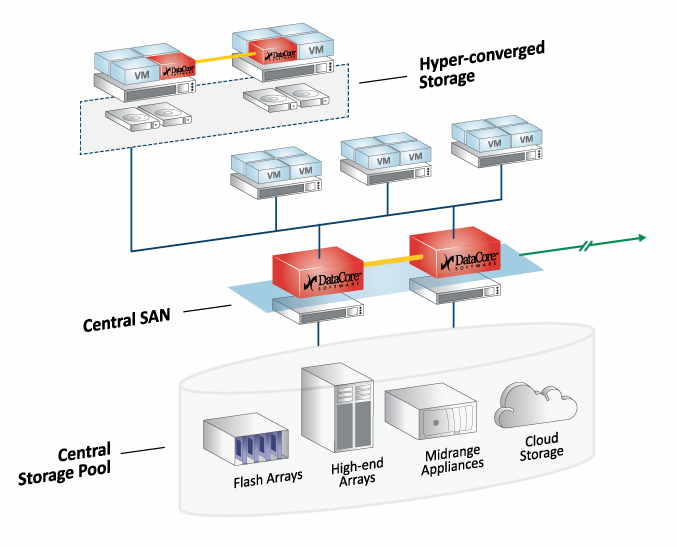
DATACORE_virtual-san-detailed

Detailed in a recently-published Industry Impact Brief, Jim Miller, senior analyst, EMA, states: "DataCore has been delivering significant cost savings with comprehensive storage services for heterogeneous environments long before the creation of the term software-defined storage. By putting multi-core servers to work using Adaptive Parallel I/O technology, DataCore has added a capability to save on capital and operational expenses for both storage and servers."

The economic and productivity impact goes beyond the 'consolidation' boom that server virtualization started, but did not finish. More VMs running on the same CPU delivered the first wave of consolidation savings but on today's multi-core systems with dozens to hundreds of CPU cores available, the potential for more savings is greatly multiplied. However as the number of CPU cores has grown, new performance issues have surfaced in virtualized environments as only a single CPU core is typically assigned by the hypervisor to process I/O operations - despite the abundance of CPU cores available. This restriction creates an 'I/O gap' between application processing and I/O processing, and when paired with the aggregation of mixed workloads, a bottleneck in performance arises.

Enterprise application workloads, and especially databases, achieved limited cost saving benefits since they had to resort to larger cluster complexes and utilize many more systems to overcome the 'I/O gap' and serial processing bottlenecks. Counter to consolidation, this led to more server sprawl to process these demanding business workloads.
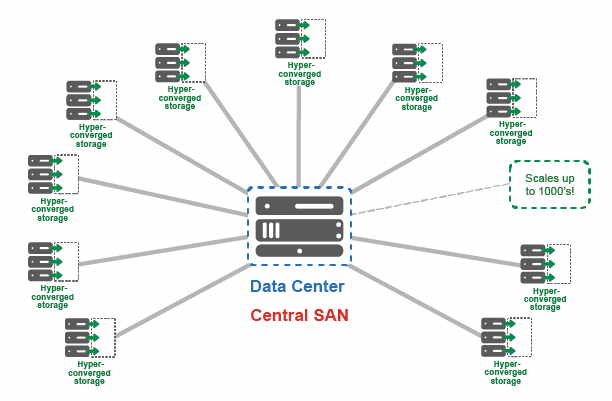
DATACORE_virtual-san-use-case-2
Company's Adaptive Parallel I/O software solves this problem by multiplying the performance of virtualized and hyper-converged systems by enabling the execution of many independent I/O streams simultaneously across multiple CPU cores, reducing the latency to service and process I/Os. Rather than serializing I/O as competing products do, parallel I/O software automatically allocates the number of core resources needed to eliminate the mismatch between computational and I/O processing. This reduces the I/O limitations and bottlenecks that restrict the number of VMs and workloads that can be consolidated on server and hyper-converged platforms. The impact of harnessing untapped multi-cores with parallel I/O software completely redefines performance and the economics of TCO; it enables the next wave of hyper-consolidation productivity that allows IT shops to 'do far more with less' and lower server and storage costs.

According to EMA, there are two primary benefits of parallel I/O software: it reduces the number of physical servers while achieving faster application response times using lower-cost, commodity-based storage hardware. This reduction in servers increases in importance as the market transitions from traditional enterprise storage (NAS, SAN, DAS) to enterprise server SAN storage, or hyper-converged systems. Next is the savings in storage costs. By treating the root cause of the problem, performance requirements can be met or exceeded with less costly storage resources. As a result, company's Adaptive Parallel I/O software enables IT organizations to reclaim the savings of virtualization that had become diminished due to the I/O gap.
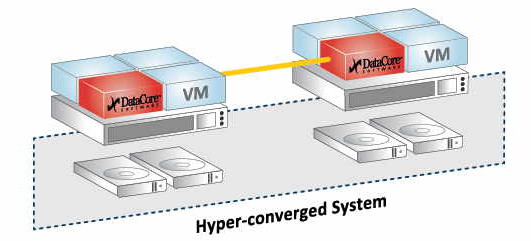
Hyper-converged System

DATACORE_virtual-san-base
The Industry Impact Brief makes note of several recent benchmarks results that independently quantify the economic and performance
capability of parallel I/O technology. The first result referenced is firm's world record for price performance ($0.08/SPC-1 IO/s) achieved withSANsymphony software-defined storage and Hyper-converged Virtual SAN software featuring Adaptive Parallel I/O technology. The company also recorded the fastest response time ever measured on the SPC-1 benchmark at that time with 0.32 milliseconds at 100% load (459,000 SPC-1 IO/s) on a hyper-converged system running on a compact off-the-shelf 2U Lenovo server, total costs were only $38,400 [i]. That's 3x to 10x faster than competing systems that cost several hundreds to millions of dollars.

Newer results validated on software from the company use parallel I/O technology to enable compact, power and space saving 2U servers to utilize multicores to multiply server performance; firm's parallel server elevated the numbers to 1.5 million SPC-1 IO/s, while setting a new record response time of 0.10 milliseconds at 100% load [ii]. The result of this is a decreased number of physical servers from five to one, offering savings in capital, software licensing, administrative effort, and environmental expense.

EMA stated that the company has long been known for delivering significant cost savings with comprehensive storage services for heterogeneous environments. Lenovo Co., Ltd, Fujitsu, Ltd.,Huawei Technologies Co., Ltd., and Dell Inc. currently offer solutions that include firm's software with their servers. As Adaptive Parallel I/O technology gains traction, EMA believes that other server vendors will follow suit and offer the company's software. Not to do so would put these vendors at a significant disadvantage.

"EMA applauds DataCore for approaching the virtualized server performance problem in a new, more efficient way," continued Miller. "DataCore was recently awarded Best Enterprise Solution for Software-Defined Storage in the recent EMA Radar Report for Enterprise Software-Defined Storage. For parallel I/O technology, DataCore currently has no competition."

Monday, 25 April 2016

DataCore Reports the Fastest Response Time and Best Price-Performance Among Top 10 SPC-1 Leaders

Parallel I/O Technology Drives More than 1.5M SPC-1 IOPS™ at a 100 Microsecond Response Time While Simultaneously Running Enterprise-class Database Workloads; Delivers SPC-1 Price-Performance™ of 9 Cents per SPC-1 IOPS™


DataCore announced that its second SPC-1 result has catapulted the company into third place among the SPC's Top 10 of absolute performers while achieving the best price-performance and fastest response times among those Top 10. DataCore again leapfrogged the field and now holds the top two positions in the SPC-1 Price-Performance™ category1. The DataCore™ Parallel Server software at the heart of the hyper-converged configuration delivered 1,510,090.52 SPC-1 IOPS™ 2. Notably, the number one and two systems3 in the category are very large footprint multimillion dollar systems that are 14 times more costly than the compact 4U-sized DataCore based solution.
"There is no magic in what we are doing," states Ziya Aral, Chairman of DataCore Software. "Yes, we use a standard 2U server but it is a server with 36 cores and 72 logical CPUs. At 2.5 GHz clock speed that multiplies out to the equivalent of 180 GHz, provided only that we use those CPUs concurrently. Even if the CPUs don't scale perfectly, we have an 'embarrassment of riches' in compute power. If they scaled at only 60% - and they do much better than that - we effectively have access to over 100 GHz of CPU power. Frankly, we would have been disappointed if we hadn't been able to put up these kinds of I/O numbers with a 100 GHz CPU."
DataCore's initial results showcasing the power of parallel I/O were first published in late 2015. The new results, which tripled the previous performance achievements, were attained on the same server platform hardware to demonstrate the potential and the pace of advancement possible from the company's new software and parallel I/O architecture. And, there is more to come.
Record-Breaking Performance
To illustrate the system's I/O power in demanding database environments, DataCore chose the Storage Performance Council's SPC-1 benchmark – the Gold Standard used by all major storage manufacturers to measure top end I/O performance, price-performance and response time. For the benchmark, DataCore used an off-the-shelf Intel-based Lenovo System x3650 M5 server.
The 1,510,090.52 SPC-1 IOPS™ were attained with the total cost for hardware, software and three years of support totaling$136,758.88. This yielded the SPC-1 Price-Performance™ result of $0.09 per SPC-1 IOPS™, which is more than eight times lower than all of the top performing high-end systems that have achieved over one million SPC-1 IOPS™ 4.
The DataCore Parallel Server configuration placed third overall in SPC-1 IOPS™ behind two systems costing over $2 million. Only the Huawei OceanStor 18800V3 at a total price of $2,370,760 and the Hitachi VSP G1000 system at $2,003,803 had higher SPC-1 IOPS™ numbers than the $136,759 solution from DataCore. Unlike those two storage systems which only provide external SAN functions, the DataCore Parallel Server also ran the computational enterprise-class database and OLTP workloads inside the same compact package.
Most remarkably, the DataCore configuration delivered the fastest SPC-1 response time ever recorded (100 Microseconds at 100% load), besting all systems, including multi-million dollar systems and all-flash arrays, by seven times or more. From a real estate standpoint, the entire system takes up only 4U (seven vertical inches for a 2U server and 2U for disks) of standard 19" rack space. In stark contrast, other systems reaching the million SPC-1 IOPS™ mark occupy multiple 42U cabinets consuming considerably more data center space, power, and cooling.
DataCore now holds the two top positions in the SPC-1 Price-Performance™ category5 (the previous DataCore™ SANsymphony™ system running on a hyper-converged configuration using a similar Lenovo System x server attained an SPC-1 Price-Performance™ record of $0.08/SPC-1 IOPS™ 6). "Essentially the only major difference between our first and second SPC-1 results was our software," notes Ziya Aral who continued by answering the obvious question - how is that possible? "The truth is that the hardware platform matters, multiprocessing matters, and I/O craft matters, but what matters most of all is software architecture. DataCore was designed from the outset for parallel architectures...but the definition of 'parallel' at the time was 4, 8, maybe 12 CPUs. Today, we are running in standard platforms with 72, 144 or even 288 logical CPU cores, and that will double with the next few ticks of the clock - because Moore's law now advances in multiples."
Aral explains further, "Parallel Server is designed to take advantage of that evolution in computer architectures - not just for the present but into the future. This software inverts our previous understanding: what was once a precious commodity now exists in surplus and the software must take advantage of it."
Tested Product: DataCore™ Parallel Server for Hyper-Converged and Server Systems
DataCore certified its results using DataCore Parallel Server software on a compact 2U Lenovo System x3650 M5 multi-core server featuring Intel® Xeon® E5-2600 v3 series processors with a mix of flash SSD and disk storage.
DataCore Parallel Server is a software product that transforms standard servers into parallel servers targeted for applications where extremely high IOPS and low latency are the primary requirements. DataCore's parallel I/O technology executes many independent I/O streams simultaneously across multiple CPU cores, significantly reducing the latency to service and process I/Os. This technology removes the serialized I/O limitations and bottlenecks that restrict the number of virtual machines (VMs), virtual desktops (VDI) and application workloads that can be consolidated on a server or a hyper-converged platform – and instead enables them to process far more work per server and significantly accelerate I/O-intensive applications.
DataCore Parallel Server software is now available to DataCore OEM partners and is currently being evaluated by server and system vendors. General availability is planned for Q2 2016.
Hyper-Consolidation and Next Generation Productivity with DataCore Parallel I/O Technology
The practical significance and business advantages of DataCore Parallel Server's record-breaking results can be appreciated from several perspectives:
  • Servers are the new storage: I/O-intensive workloads which had previously required enormous investments in exotic SAN hardware or enterprise-class external arrays can now be addressed with relatively inexpensive, compact, off-the-shelf hardware equipped with DataCore Parallel Server software.
  • One machine is simpler than many: Organizations no longer need to split I/O-intensive problems across hundreds of servers to reduce their dependency on exotic equipment. They can run these programs unaltered inside a few low-cost servers without undue complexity, delay and expense.
  • Hyper-consolidation versus server sprawl: Several years into virtualization initiatives, serial I/O processing inside servers remains singularly responsible for poor virtual machine densities. By putting multiple CPU cores to work on I/O, DataCore helps customers do the work of 10 servers on one or two.
DataCore's Parallel Server software enables industry-standard x86 servers to fully harness their untapped parallel computation power and gain the essential I/O functionality needed to drive today's demanding tier-1 business application requirements. In this way, companies benefit from dramatically higher productivity and huge server consolidation savings. To learn more visit: www.datacore.com/products/parallel-io.
About the Storage Performance Council
The Storage Performance Council (SPC) is a vendor-neutral standards body focused on the storage industry. The SPC created the first industry-standard performance benchmark targeted at the needs and concerns of the storage industry. From component level evaluation to the measurement of complete distributed storage systems, the SPC benchmark portfolio provides independently audited, rigorous and reliable measures of performance, price-performance and power consumption. For more information about the SPC and its benchmarks, please visit: http://www.StoragePerformance.org.

Wednesday, 13 April 2016

Research on nearly 2,000 DataCore Customers and Software-Defined Storage Confirms Performance, High Availabilty and Lower Cost of Ownership are the Primary Business Drivers

Transdev Australasia
Data from Nearly 2,000 DataCore Customers Uncovers Impact of Software-Defined Flexibility on Acquisitions, Refreshes and Migrations; Productivity Gains from Increasing Performance Up to 10x and Reducing Total Cost of Ownership
DataCore has announced the results of a new research study conducted by TechValidate. The study primarily focused on the experience of DataCore customer’s in terms of performance, availability/reliability and total cost of ownership (TCO). Overall, participants reported faster applications with up to 10x performance increases; higher availability with a 90% or greater reduction in storage-related downtime; substantial reduction in costs; and greater productivity with the majority of respondents reporting a 50-90% decrease in time spent on routine tasks.
Highlights from the findings include:
  • 47% of customers reported a 50% or more reduction in storage-related spending; over 80% of customers reported at least 25% savings.
  • The majority of customers reported that they were able to defer or skip multiple refresh cycles, and over 60% saved by deferring storage hardware acquisitions by using DataCore to extend the life and enhance the productivity of current investments.
  • 79% of customers reported improvements of at least 3x, and nearly half of the DataCore customers surveyed reported performance improvements between 5x-10x.
  • 60% reduced storage-related downtime with DataCore by 90% or more; the majority of customers who had systems deployed for two years or more reported no storage-related downtime whatsoever.
  • 72% of respondents reported a 50% or more decrease in time spent on managing routine storage tasks, with some noting a reduction as high as 90%.
  • All respondents reported a positive ROI with DataCore in the first year; 50% reported a positive ROI in six months or less.
These findings further support that DataCore offers the best performance and the lowest TCO in the industry by complementing new data recently published by the Storage Performance Council (SPC). In a series of recently released SPC-1 benchmarks, DataCore’s current SANsymphony and Hyper-converged Virtual SAN software achieved the industry’s best price-performance, coming in at just $0.08 cents per SPC-1 IOPS™. The results also measured incredibly fast response times of just 0.32 milliseconds [1] which were achieved while running the full load of the demanding enterprise-class application and database benchmark. At 0.32 milliseconds, the results are 3x-10x better than all other reported results including those from all-flash arrays and million dollar plus systems.
Stennis Space Center

To highlight the full impact of parallel I/O on performance, DataCore recently announced the results of new software that will enable servers to utilize multicores to multiply performance. The software, available in Q2, has demonstrated an incredible result of more than 1.5 million SPC-1 IOPS™ with a new world record response time of just 0.10 milliseconds at 100 percent load [2].
“This is game changer which is ahead of the trend and a key element to help organizations truly be able to have a software-defined data center,” DataCore customer Irvin Nio, IT Architect at Capgemini, noted during the survey.
The new level of enterprise-class high availability and reliability proved by TechValidate research can be attributed to DataCore’s features including hardware interoperability, hardware-independent storage services, data migration capabilities, and more. DataCore’s latest addition to its technology portfolio, parallel I/O, uniquely takes advantage of today’s advanced multi-core server platforms to execute many independent I/O streams simultaneously across multiple CPU cores – supporting the I/O needed to run more VMs and application workloads faster and at a much lower cost. It significantly reduces the latency to service and process I/Os while enabling companies to benefit from dramatically higher productivity and huge server consolidation savings.
A total of 1,984 responses were recorded from DataCore customers globally.TechValidate research data is sourced directly from verified business and technology professionals. The full findings of the study can be viewed at: https://www.techvalidate.com/product-research/datacore-sansymphony-v .
___________________

Tuesday, 12 April 2016

Software-defined data centers and the need for parallel I/O hyper-consolidation and performance

"Parallel I/O is essentially like a multi-lane superhighway with “EZ pass” on all the lanes. It avoids the bottleneck of waiting on a single toll booth and the wait time. It opens up the other cores (all the “lanes” in this analogy) for I/O distribution so that data can continue to flow back and forth between the application and the storage media at top speed."
By George Teixeira, President and CEO, DataCore Software
In the software-defined data center (SDDC), all elements of the infrastructure such as networking, compute, servers and storage, are virtualized and delivered as a service. Virtualization at the server and storage level are critical components on the journey to a SDDC since they enable greater productivity through software automation and agility while shielding users from the underlying complexity of the hardware.
Today, applications are driving the enterprise – and these demanding applications, especially within virtualized environments, require high performance from storage to keep up with the rate of data acquisition and unpredictable demands of enterprise workloads. The problem is that in a world that requires near instant response times and increasingly faster access to business-critical data, the needs of tier 1 enterprise applications such as SQL, Oracle and SAP databases have been largely unmet. For most data centers the number one cause of these delays is the data storage infrastructure.
Why? The major bottleneck has been I/O performance. Despite the fact that most commodity servers already cost-effectively provide a wealth of powerful multiprocessor capabilities, most sit parked and in idle mode, unexploited. This is because current systems still rely on device-level optimizations tied to specific disk and flash technologies that don’t have the software intelligence that can fully harness these more powerful server system technologies with multicore architectures.
While the virtual server revolution became the “killer app” that exploited CPU utilization and to some degree the multicore capabilities, the downside is that virtualization and the move to greater server consolidation created a workload blender effect in which more and more of the application I/O workloads were concentrated and had to be scheduled on the same system. All of those VMs and their applications become easily bottlenecked going through a serialized “I/O straw.” As processors and memory have dramatically increased in speed, this I/O straw continues to bottleneck performance — especially when it comes to the critical business applications driving databases and on-line transaction workloads.
Many have tried to address the performance problem at the device level by adding solid-state storage (flash) to meet the increasing demands of enterprise applications or by hard-wiring these fast devices to virtual machines (VMs) in hyper-converged systems. However, improving the performance of the storage media—which replacing spinning disks with flash attempts to do—only addresses one aspect of the I/O stack. Hard-wiring flash to VMs also seems to be a contradiction to the concept of virtualization in which technology is elevated to a software-defined level above the hard-wired and physical aware level, and it also adds complexity and vendor specific lock-ins between the hypervisor and device levels.
Multi-core processors are up to the challenge. The primary element that is missing is software that can take advantage of the multicore/parallel processing infrastructure. Parallel I/O technology enables the I/O processing to be done separately from computation and in parallel to improve I/O performance by building on virtualization’s ability to decouple software advances from hardware innovations. This method uses software to drive parallel I/O across all of those CPU cores.
Parallel I/O technology can schedule I/O from virtualization and application workloads effectively across readily available multicore server platforms. It can overcome the I/O bottleneck by harnessing the power of multicores to dramatically increase productivity, consolidate more workloads and reduce inefficient server sprawl. This will allow much greater cost savings and productivity by taking consolidation to the next level and allowing systems to do far more with less.
640px-EZPass_logo.svg
Parallel I/O is essentially like a multi-lane superhighway with “EZ pass” on all the lanes. It avoids the bottleneck of waiting on a single toll booth and the wait time. It opens up the other cores (all the “lanes” in this analogy) for I/O distribution so that data can continue to flow back and forth between the application and the storage media at top speed.
The effect is that more data flows through the same hardware infrastructure in the same amount of time as legacy storage systems. The traditional three-tier infrastructure of servers, network, and compute benefits by having storage systems that directly respond and service existing I/O requests faster and thus have the capability of supporting significantly more applications and workloads on the same platforms. The efficiency of a low-latent parallel architecture is potentially more critical in hyper-converged architectures, which are a “shared-everything” infrastructure. If the storage software is more efficient in its use of computing resources, that means that it returns more available processing power to the other processes on which it runs.
By taking full advantage of the processing power offered by multicore servers, parallel I/O technology acts as a key enabler for a true software-defined data center. This is due to the fact that it avoids any special hardwiring that impedes achieving the benefits of virtualization while it unlocks the underlying hardware power to achieve a dramatic acceleration in I/O and storage performance – solving the I/O bottleneck problem and making the realization of software-defined data centers possible.

Sunday, 10 April 2016

ESG’s Senior Lab Analyst shares his hands-on experiences with DataCore Hyper-converged Virtual SAN software and SANsymphony Software-defined Storage platform

ESGlab
ESG’s Senior Lab Analyst, Tony Palmer, shares his hands-on experiences with DataCore™ Hyper-converged Virtual SAN software and SANsymphony™ Software-defined Storage platform.  See how the products fared under a comprehensive battery of tests, exercising many of their enterprise-class features. Learn why these capabilities matter, especially to IT organizations tasked with non-stop operations, latency-sensitive workloads and cost-reduction mandates.

Get a glimpse for self-provisioning storage with the desired SLAs during virtual machine creation thanks to DataCore’s deep integration with VMware VVols. Observe the performance acceleration and savings that cross-array auto-tiering brings. And witness active-active, high-availability in action for failover clusters.

Tony also puts into perspective the significance of DataCore Parallel I/O technology – key to the company’s record-shattering results for I/O response and price-performance under heavy transactional database processing.

Download the complete Lab Validation Report.

Tuesday, 15 March 2016

DataCore Parallel I/O Software Takes the Gold in the Storage System Software Category of Storage Magazine/SearchStorage.com Products of the Year Awards

DataCore, the leader in Parallel-Powered Software-Defined Storage, Application-Adaptive Data Infrastructure and Hyper-converged Virtual SAN solutions, today announced that its Adaptive Parallel I/O software was named a Gold winner in the Storage System Software category of the 2015 Products of the Year Awards announced this month by Storage Magazine/SearchStorage.com. The awards, presented annually by the editors of TechTarget's Storage Media Group, were judged by the Storagemagazine/SearchStorage.com editorial staff, in conjunction with a team of users, industry experts, analysts and consultants.

The judging panel rated DataCoreTM Adaptive Parallel I/O first in performance among the 13 finalists in the Storage System Software category. Comments from the judges included that there is nothing else like DataCore's Adaptive Parallel I/O on the market, and one called the software "potentially revolutionary." Another noted that most software-defined storage products, or storage virtualization, are not capable of parallel I/O.

The award comes on the heels of DataCore setting a new world record for price-performance in the Storage Performance Council's SPC-1, the industry's most recognized and peer reviewed storage benchmark. Due in large part to the breakthroughs of parallel I/O technology that harnesses the untapped power of multi-core processors, DataCore achieved an audited SPC-1 Price-Performance of $0.08 per SPC-1 IOPS, making it the number one result for SPC-1 Price-Performance overall. This result was certified with DataCore's SANsymphony and Hyper-converged Virtual SAN software featuring parallel I/O technology on a powerful 2U Lenovo System x3650 M5 multi-core server featuring Intel® Xeon E5-2600 v3 series processors. On this same platform, DataCore also booked record-breaking response times of 0.32 milliseconds at 100% load. At the incredibly fast 0.32 milliseconds response time, the results are 3x-10x better than all other reported results including those from all-flash arrays and million dollar plus systems.

Additionally, DataCore received a Silver Stevie Award for the Front-Line Customer Service Team of the Year - Technology Industries Category of The Stevie Awards for Sales & Customer Service in March, the world's leading sales, business development, contact center, and customer service awards. This tops off a banner year for DataCore in 2015 when its SANsymphony-V and DataCore Hyper-Converged Virtual SAN both received the Virtualization Review 2015 Editor's Choice Awards, with DataCore SANsymphony-V being called one editors' "favorite technology product in 2015." The readers of Storage-Insider and IT Business also awarded SANsymphony-V with the Reader's Choice Award for Best Software-Defined Storage.


Furthermore, Enterprise Management Associates (EMA) named DataCore Software's SANsymphony-V the "Best Enterprise Solution for Software-Defined Storage" in the EMA Radar Report for Enterprise Software-Defined Storage. DataCore SANsymphony-V was named a category value leader in the same report.

Friday, 12 February 2016

Enterprise Strategy Group’s New Lab Report Validates DataCore Parallel I/O Performance, Virtual Volume Advances and More…


The New Report Spotlights the Top 10 Biggest Storage Challenges” and Details Test Results on DataCore’s Application-Adaptive Data Infrastructure, Self Provisioning VVols, Hyper-converged Simplicity, Parallel I/O Performance, Automated Storage Tiering, Continuous Data Protection and More

“It would benefit any organization considering or implementing an IT virtualization project to take a long look at DataCore Software.” - Tony Palmer, senior lab analyst, ESG Lab
A new hands-on evaluation and testing report performed by Enterprise Strategy Group (ESG) Lab covering DataCore SANsymphony and Hyper-converged Virtual SAN software has just been released.

“DataCore’s SANsymphony and Hyper-converged Virtual SAN solutions proved to be robust, flexible, and responsive. The company now finds itself with incredibly relevant capabilities that truly matter to users. We found the software easy to implement and manage, virtualizing any storage infrastructure with enterprise-class features and functionality while enhancing performance,” said Tony Palmer, senior lab analyst, ESG Lab. “ESG Lab was especially impressed with DataCore’s parallel I/O technology and its ability to deliver enterprise-class performance running on low-cost commodity hardware.”

The report also highlights ESG’s survey results on the “Top 10 Biggest Storage Challenges.” The lab testing, performed independently, was done to assess the value of DataCore’s infrastructure-wide storage virtualization and hyper-converged solutions for the data center, and the tests were designed to validate the flexibility and ease of management in a heterogeneous, highly virtualized environment. ESG also examined DataCore Software’s performance, efficiency, and availability in fully virtualized and hyper-converged configurations.

ESG Lab Validation Highlights:
  • Enables Enterprise-class Hyper-converged Data Infrastructure
ESG Lab found that virtualizing infrastructure with DataCore Hyper-converged Virtual SAN was intuitive and straightforward. During the evaluation, a pair of servers running a hypervisor and DataCore Hyper-converged Virtual SAN provided a highly available platform to run multiple simulated applications and enterprise workloads. When a server failure was simulated with a hard power off, virtual machines and storage failed over to the surviving node immediately and automatically. A new server was installed and added to the Failover Cluster–seamlessly and painlessly–while applications remained online and continously available.

DataCore Hyper-converged Virtual SAN            

ESG also tested, reviewed and reported on DataCore’s ability to go beyond traditional hyper-converged performance limits and run demanding enterprise-class application and storage workloads. DataCore’s hyper-converged solutions provide a range of performance and application adaptive acceleration capabilities, the most significant being its parallel I/O software.
“DataCore has been hyper-converged since before there was such a term in the industry, so it’s no surprise that its hyper-converged offering is robust, highly available, and offers very impressive price-performance with the full complement of enterprise-class functionality that DataCore has been honing for nearly two decades,” added Palmer.

  • Drives Fastest Response Times and Industry-best Price Performance
DataCore’s parallel I/O software technology is designed to adaptively harness available multi-core processors to optimize and schedule I/O processing across many different cores simultaneously. It actively senses I/O load being generated by multiple VMs concurrently and dynamically assigns CPU cores as needed to process the I/O load. This enables DataCore to take full advantage of modern multi-core server technologies to eliminate I/O bottlenecks, speed up application performance, and drive greater workload and virtual machine density per server.

ESG Lab reviewed DataCore’s recently-published Storage Performance Council SPC-1 benchmark results. “DataCore has published an excellent result of 459,290 SPC-1 IOPS at 100% load with an average response time of only 0.32 milliseconds in a hyper-converged configuration1,” continued Palmer. “The 0.32 millisecond result at 100% load is the fastest response time ever reported by SPC-1, and showcases the power of parallel I/O software to significantly reduce the time it takes for applications to access, store, and update their data.”

DataCore set a new SPC-1 price-performance record. At full load, SANsymphony was responding at nearly two orders of magnitude below the 30 milliseconds response time threshold set by the Storage Performance Council and at 0.32 milliseconds, it is three times faster than the one milliseconds threshold considered to be the standard for all-flash systems.

ESG stated that the DataCore SPC-1 result proves its suitability for response time sensitive applications (e.g., Virtualization and Database workloads, OLTP, ERP, etc.) and demonstrates the headroom available to scale up and scale out to much larger configurations and capacities.

  • Simplifies VMware vSphere Storage Management: Self-Provisioning with VVols
Administrators crave the simplicity, power and fine-grain control promised by vSphere Virtual Volumes (VVols); however, most current storage arrays and systems do not support VVols. With DataCore enabled, virtually any storage becomes VVol capable allowing VMware vSphere administrators to self-provision virtual volumes from virtual storage pools -- and instantly specify the capacity and class of service needed for their applications without having to know anything about the storage or underlying hardware.

ESG Lab tested DataCore self-provisioning VVols. In the testing scenario, ESG set up Platinum, Gold, Silver, and Bronze policies to define different levels of service. DataCore made provisioning storage a seamless, integrated part of VM creation, empowering administrators to provision storage for virtual machines using predefined storage policies that were able to define performance, availability, and locality of data without ever having to touch the back-end storage.

DataCore automatically took care of the entire behind-the-scenes configuration, which is the responsibility of specialized storage administrators in traditional storage environments. ESG Lab reported that it was impressed with the speed, simplicity, and completeness of the DataCore integration. Virtual machines based on these predefined profiles were created in minutes using native VMware tools. ESG noted that this capability is particularly of value as much of the existing storage in data centers can never be retrofitted to support VVols, so the fact that SANsymphony extends VVols self-provisioning to existing storage investments and any new devices not yet able to support VVols is a powerful capability.

  • Automates Infrastructure-wide Storage Tiering to Maximize Cost-Effective Performance
ESG Lab also validated the business value of DataCore’s automated storage tiering. All performance testing was completed using test tools to simulate a typical OLTP workload. ESG first measured the performance on a non-tiered storage pool using a SAS disk. Next, an SSD was added to the storage pool. The software immediately started the rebalancing process of tiering, moving hot, or frequently accessed, data blocks from the SAS disk to the higher performance flash disk.
After completing the rebalancing process, the DataCore solution dedicated all resources to performing storage operations for the application. The effect of storage tiering was immediately visible, the DataCore software reported a total of 1,392 IOPS—a 700% improvement over the non-tiered storage pool.

  • Supports Continuous Availability, Metro-wide Clustering, Remote Disaster Recovery, Advanced Data Protection and Automated Failover and Self-healing Functionality
ESG Lab further validated that DataCore SANsymphony and Hyper-converged Virtual SAN provide an array of advanced data protection capabilities that can cost-effectively satisfy the most stringent business continuity and disaster recovery requirements. Synchronous mirroring across metropolitan areas, automated failover and self-healing, full and incremental snapshots, roll-back in time 

Continuous Data Protection (CDP), and asynchronous remote replication to distant disaster recovery sites can all be used without being dependent on any specific model or brand of storage device. For example, customers can take advantage of a hyper-converged system at a remote site and establish it as a contingency site for larger data centers.

ESG also noted that DataCore’s CDP capability was easy to configure and use, enabling rollback to a specific point in time without having to create multiple snapshots. An ideal solution for recovering the state of applications and configurations prior to bad events when snapshots were not invoked or to recreate ‘any-point in time’ restores.

View the ESG Lab Report and the Top 10 Biggest Storage Challenges
In addition to the lab report on DataCore, ESG recently conducted a survey of 373 IT professionals and respondents who were asked to identify what they would consider to be their biggest challenges with respect to their storage environment. As one might expect from a captive audience of server virtualization users, there was significant focus on both data growth and data protection (each cited by 26% of respondents), as well as staff costs and data migration (coming in at 23% each). Perhaps of greatest interest and significance, however, is that hardware costs (27%) was the most-cited storage challenge.

Bottom-line, in addition to the added flexibility to deal with growth and change, overcoming total cost of ownership including the rising people and hardware costs are now the primary business motivators driving the increased momentum to deploy software-defined storage solutions such as those from DataCore.

View the complete ESG Lab Report and Survey Information here.